Sunday, February 8, 2009

Quick Walk Through Huntington Central Park


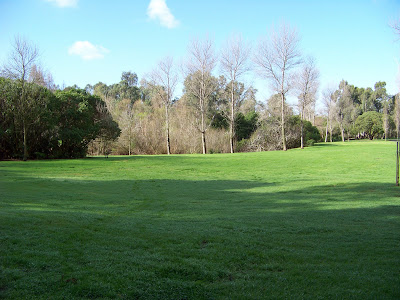
After the rain, seemed like a nice day in the park. Just a few scattered clouds.

It was a nice break after the rain. Sunny skies and scattered clouds. I drove over to Huntington Central Park. Hoping yet again to see the Cedar Waxwings there. I was hoping to hear bagpipes (see A Little Bit of Scotland in Huntington Central Park), but no luck there either.


Birds flitted through the undergrowth and the trees overhead as I came in through the Gothard entrance. But no Cedar Waxwings. I heard a loudly calling Red-Shouldered Hawk and located him in a tall eucalyptus tree.


Western Bluebird male.

I saw something flying down from a tree and back up like a flycatcher almost. But not a flycatcher of any kind. It was a Western Bluebird. They are back. Time to check out the parks for these little brightly colored birds.


Male Western Bluebird in the foreground. Female Western Bluebird behind him.

They were being very cooperative.


Cassin's Kingbird

Saw a Cassin's Kingbird doing much the same.


I saw something moving up a tree trunk and thought it was a woodpecker. Instead I saw an Audubon Yellow-Rumped Warbler.


There were Audubon Yellow-Rumped Warblers all over the park.


Cassin's Kingbird

This was a very active Cassin's Kingbird.


Cassin's Kingbird


Ominous, dark storm clouds.

I never did see any Cedar Waxwings. I met another bird/nature photographer. Finally, the dark clouds rolled in. I had no desire to get soaked, and I headed back to the my car. Birding between rain showers can be fun, but this looked like a real storm. Have fun birding in Orange County!


Home - Index - Contact - Shop - Ask the OC Birder Girl - OC Birder Girl Videos

Saturday, February 7, 2009

Between Rain Showers at the Back Bay

The wetlands lived up to their name on Saturday.

This Saturday between rain showers I would classify the wetlands at Upper Newport Bay Ecological Reserve as highly soggy. The water level were as high as I have ever seen them.


Very Soggy.


Saw a Great Egret or two.

There were Great Egrets, Snowy Egrets, and Great Blue Herons wading in the wetlands.


Female Northern Harrier hunting low over the wetlands. The Female is brown.


The male Northern Harrier hunting. The Male is gray.


Northern Harriers are commonly seen at Upper Newport Bay Ecological Reserve, San Joaquin Wildlife Sanctuary,and at Bolsa Chica Ecological Reserve. They used to be called Marsh Hawks because that is were they are usually seen. The male is gray and the female is brown, but both have a white area on the rump. The face is owl-like. They fly low to the ground or water, looking for prey. The pair I saw was hunting almost the entire time I was there. Every now and then, they would find a dry spot and sit in the pickleweed. They often sit on the ground or a low perch. Northern Harriers are also known to perch higher up.


Beautiful Stormy views.


It was cold. And muddy. There wasn't much out. I saw a Say's Phoebe at a distance, but couldn't get close enough for a picture.


Stormy weather.


The views of the wetlands and the clouds alone were worth the walk.


Up by the Muth Interpretive Center on the mesa, you will find a lot of different birds. I saw the White-crowned Sparrow above.


California Towhee

Notice Cinnamon highlights


and undertail coverts.

On the mesa, I have also seen Western Meadow Larks, Common Yellowthroats, and House Finches in addition to White-crowned Sparrows and California Towhees.


The View of the snow-capped mountains in the distance through the clouds was beautiful.
Rainy days are great days for birding in Orange County or anywhere. Whatever the weather, have fun birding in Orange County!


OC Birder Girl Links


All about our watershed. What is a watershed? Read this post to find out.

Northern Harrier


Home - Index - Contact - Shop - Ask the OC Birder Girl - OC Birder Girl Videos

Tuesday, February 3, 2009

Sapsucker, Which Sapsucker Are You?

The back. Is it messy? Or are those two rows of bars? No red nape.

I went on the the monthly Audubon walk at Santiago Oaks Regional Park. The leader, Linette, took us first to a pepper tree a bit in from the parking lot. There was a sapsucker moving in the branches. The sapsucker did its thing which is sucking sap as it moved around and up and down the pepper tree sticking its bill into sap wells it had made or making new ones. A Yellow-bellied or Red-naped Sapsucker? That was the question we were all trying to answer as it moved in and out of the foliage covering the trunk. Not the best views.


Red on the head. See the sap wells on the trunk of the pepper tree?


Now Linette took us there for a reason. Sapsuckers are known to be in this pepper tree, and if you look in the OC Rare Bird Alert, you will see that a Yellow-bellied has been spotted here over the last five years in what appears to be this very pepper tree. But before we jump to conclusions, let me say Red-naped have also been seen in this tree. So, we still have to look carefully. One account on the OC Rare Bird Alert talks about a Red-naped Sapsucker and a Yellow-bellied Sapsucker "playing hide and seek" in the same tree.


Again, no red nape, could be two rows of bars or in comparison is this messy?


It is mentioned in many places on the Internet that sapsuckers eat berries from the pepper tree and other trees such as elderberry. Several accounts on the Internet mention pepper trees and sapsuckers. Sapsuckers tend to return to the same trees year after year. Some types of holes the sapsuckers may need frequent maintenance to produce sap.


Why do sapsuckers always stay so close to the trunk sucking sap? How about a nice break out in the open in a nice sunny spot?


Back to the question of which sapsucker was moving around the trunk of the pepper tree at Santiago Oaks Regional Park. Well, the differences between the Red-naped and the Yellow-bellied Sapsuckers are small and inconsistent. It won't be easy. Looks like the back may be the most consistent difference. So, I am listing the differences in appearance to sort it out--if we can.


Here's the scoop:


Red-naped Sapsucker--Not Rare


The nape is usually red, but not always.


Female has red chin with some white, but sometimes it is all red.


The female also has a red nape, but not always. Sometimes it's white.


The red chin is bordered by an incomplete or broken black line.


Has white barring on the back in two rows.


Is the line around the red under the chin broken or solid? Hard to tell here.


Yellow-bellied Sapsucker--Rare


The nape has no red, except sometimes it does have red.


Females has a white chin.


The red chin on the male is completely bordered by a thick, black line.


Has extensive white barring on the back. Kind of "messy" looking some say whatever "messy" looks like.


Black border around the red looks solid here.


According to Sibley, most western birds of both species tend to have more red. And we are in the West. Can't get much further west unless its Bolsa Chica or Upper Newport Bay.


Could be solid.


So let's look at some more pictures. It wasn't even a dark and stormy night, but they came out kind of dark.


Hmmmmm.


Sure is a busy little Sapsucker!


Not much help here.


Definitely all red under the chin. For what it's worth.


Here is my video of the sapsucker that is either a Red-naped Sapsucker or a Yellow-bellied Sapsucker. You can see it in HD at my vimeo site here. So for what it is worth, here it is:


So we await the official determination from our walk's leader. When the decision comes out, I will post it. Until then, have fun out in the OC birding near the shore or in the oak woodlands or in the hills. Sometimes birding in Orange County brings up a challenging mystery to solve. There are lots of great places to bird in Orange County. So have fun birding in Orange County!


I have included a number of Yellow-bellied Sapsucker Videos and a Red-naped Sapsucker videos done by other people that they graciously allow other people to embed in their sites. So take a good look and get a feeling for what these sapsuckers look like in good light.


Check out Birdfreak's video of a Yellow-bellied Sapsucker. Has a great blog called BirdFreak . Check it out.


Another video:


Check out this terrific Video on Vimeo from Maine Nature diary. Great views of Male Yellow-bellied Sapsucker.


Take a look at the video above. Absoluely awesome shots of the Yellow-bellied Sapsucker.


Narrated video of Yellow-bellied Sapsucker from Barfsoup on YouTube. Nice view.


External Links and Resources


Very high quality video.


Home - Index - Contact - Shop - Ask the OC Birder Girl - OC Birder Girl Videos