Tuesday, January 1, 2008

White-Tailed Kite--Elanus leucurus

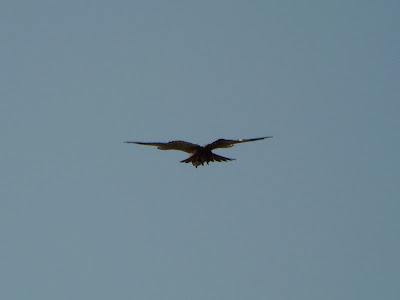
White-tailed Kite hovering over the field by the parking lot at Bolsa Chica Ecological Reserve.


Birding in Orange County is almost always exciting. I was about to leave Bolsa Chica Ecological Reserve when a man came up to me at my car. "Have you seen the kites?" he asked.

"No," I answered.

"Well, don't leave yet. If you stand over there, you will probably see them in a few minutes. They keep coming back."

So tired as I was, I went to the indicated spot and waited. And waited. The man was so sure that I just stayed there for almost 10 minutes standing at the edge of the parking lot. Sure enough, two White-tailed Kites began to hover over the lot. I snapped and snapped. I took video. It was wonderful. I never saw the man again. I want to thank him. He was kind enough to take the risk and tell a stranger about an unusual bird, and I reaped the reward. What a great birder/photography guy! A real Birding Angel. Thank you, whoever you are!


White-tailed Kite hovering, looking for food.


White-tailed Kites were originally considered one species with Black-Shouldered Kites, but were separated out as distinctly different enough to be a separate species.

Kites are fast-moving birds that hover as they look for prey. They need large areas of grasslands or marshland to hunt rodents like mice, rats, and gophers. Oddly, they also can be found at some cemeteries--which is logical when you think about it. Knowing their diet is a key to identifying at times, since you will never see a White-tailed Kite hover over a body of water looking for fish. They do not eat fish. Feel blessed if you see this medium-sized raptor. They are not as common as they used to be in Orange County.


White-tailed Kite

The White-tailed Kite is a medium-sized hawk. It is about 15 inches in length and has a wingspan of 39 inches. (The Sibley Guide to Birds by David Allen Sibley). Sibley also mentions that the plumage is very "tern-like." This is something to keep in mind since terns can appear in the same habitat as White-tailed Kites. Bolsa Chica Ecological Reserve, Upper Newport Bay, and San Joaquin Wildlife Sanctuary are some habitats that you might find both.


You Tube Video of a White-tailed Kite


There are a few species that you might confuse if you don't look closely. The Osprey can be seen in similar habitats if there is water there, but there are significant differences. The American Kestrel can be seen in similar habitats, but again, there are significant differences. See below for details.


Similar Species

The Osprey--Black-and-White Bird of Prey/Hovering Bird

Although the Osprey hovers on occasion over the water before diving, it is much larger size in size than the White-tailed Kite. It also has much more black on the wings and on the tail. Compare the bills. The Osprey has a large, black hooked bill. The White-tailed Kite's is a small black bill. Hovering is one of its hunting techniques and is done almost always over the water. In fact because their diet is almost exclusively fish, you will see Osprey by the water. Where both fish and large fields or marshland habitat are found, you may see both species. For example, both are seen at Bolsa Chica Ecological Reserve, San Joaquin Wildlife Sanctuary, and Seal Beach National Wildlife Refuge.


Immature Osprey up a tree.


Osprey in flight--Courtesy US Fish and Wildlife Service


Notice that the Osprey has lots of black on the wings when viewed from underneath. Much different than the White-tailed Kite. The Osprey is also much larger. According to "All About Birds," the Osprey is about 21-23 inches long, and its wingspan is 59-71 inches.


American Kestrel--Hovering Bird of Prey


Male American Kestrel


Female American Kestrel hovering over the Mesa at Bolsa Chica Ecological Reserve

The American Kestrel is a smaller hawk that sometimes hovers. It hovers over fields like the White-tailed Kite, but is smaller than the White-tailed Kite. The colors are also different. American Kestrel females are brown and the male, is more brightly colored with slate blue on the wings. The tail is barred--contrasted with the pure white tail of the White-tailed Kite. The American Kestrel is a cute, little bird. According to "All About Birds," the American Kestrel is between 9-12 inches. Its wing span is 20-24 inches. The White-tailed Kite is 15 inches in length and has a wingspan of 39 inches. It seems like a small difference in length, but when you see it overhead hovering, the difference is clear that this is a bigger bird.


Northern Harrier--Hovering Bird


Female Northern Harrier. Note the owl-like face. Like owls, it depends on sound as well as sight to locate prey.

The Northern Harrier is most often seen flying low over wetlands looking for prey. The female is brown and the male is gray. The two most prominent filed marks are its owl-like face and its white rump. It does hover over the marsh, and its name used to be "Marsh Hawk." But it is larger than a White-tailed Kite and tends to fly low over the ground with its white rump showing. It will perch on a mound of earth as well as in trees. The Northern Harrier female is brown, and the male is gray. Both have the white rump. Length is 17-23 inches and Wingspan is 38-48 inches. This is a larger raptor than the White-tailed Kite.


Forster's Tern--Hovers

Forster's Tern--note the orange webbed feet, black cap and long, orange bill.

Terns eat fish. They also hover, but you will see them hovering over water just before they dive for fish on occasion. So, this tern has different feet, diet, bill, and behavior. If you see a large, pointed orange bill, you are looking at a tern of some kind. The feet are webbed, not talons like the White-tailed Kite, and the wings are more pointed. Length is 14.5 inches and Wingspan is 31 inches. It is slightly smaller than the White-tailed Kite.


Least Tern--Hovering behavior


Least Tern--note the long, pointy yellow bill, the yellow feet.

This bird eats fish like the Forster's Tern. It has a large, pointed yellowish bill. The feet are webbed and don't resemble the talons at all. The wings are more pointed than the White-tailed Kite. Length is 9 inches and Wingspan is 20 inches. It is significantly smaller than the White-tailed Kite.


White-Tailed Kite from OC Birder Girl on Vimeo.

First I focused on a White-tailed Kite who was far away, then suddenly one appeared almost overhead. Listen to the other cameras clicking away. This pair drew quite a crowd. Since my camera is set to make no sound, none of those clicks are mine.


Conservation Status

According to California Fish and Game the White-tailed Kite is "Fully Protected" in the State of California, but has no federal status. See the Great Backyard Count of White-tailed Kites in California this year (2008) by clicking here. See totals for the whole United States here.

If you see a White-tailed Kite while you are out birding in Orange County, please make sure you notify Sea and Sage Audubon. Check out their White tailed Kite Study page.


OC Birder Girl Links


Osprey--Pandion haliaetus

A bird you may see in Orange County in many places including Orange County parks.


Bolsa Chica Ecological Reserve


A great place to go birding in Orange County.


San Joaquin Wildlife Sanctuary


Terrific place to go birding in Orange County.


External Links and Resources


All About Birds: White-tailed Kite

Detailed article includes Cool Facts, Description, Similar Species, Sound, Range, Habitat, Reproduction, Conservation Status, and Other Names.


Audubon Species Monitoring: White-tailed Kite

Species monitoring in Santa Barbara, California.


Bird Cinema: Immature White-tailed Kite

Immature White-tailed Kite. And a mature kite hovering.


BirdWeb: White-tailed Kite

Detailed article includes general description, pictures, habitat, behavior, diet, nesting, migration status, conservation status, and maps.


Conservation Science Institute: White-tailed Kites


Status of White-tailed Kites in California--especially San Diego. Very interesting.


More Mesa Preservation Coalition: White-tailed Kite

More Mesa is an organization in California that strives to preserve mesa areas. This is their section on the White-tailed Kite. It has an introduction and several links to such things as Distribution, Description, Hunting, Habitat, Nesting, Hatching, Fledgling, Roosting, Territory, Status, and References.


Landscape characteristics surrounding White-tailed Kite nest sites in southwestern California--A Thesis by Chris Anne Niemela


If you are up for it, read the 64 page thesis on Orange County White-tailed Kites nest sites in California. Lots of data.


The Peregrine Fund: White-tailed Kite

Detailed article from the Peregrine Fund.


Sea and Sage Audubon: White-tailed Kite Study

You can sign up to help observe White-tailed kites in your area. Do you see White-tailed Kites in your area? Read this page and see what you can do to help. Also read the related article posted on Sea and Sage from LA Audubon about White-tailed Kites in Southern California: The Trouble with Kites....


USGS: White-tailed Kite

Short Article.


The White-tailed Kite by Gail Pickwell

An interesting, though dated, article from a 1930 issue of the Condor that examines condor habits from habitat to nesting and speculates on what is causing the decrease in population. Nice description of Santa Clara nesting sites. Good picture given of White-tailed Kites at the time. Although this is a narrower population than what we call the "White-tailed Kite," the article still has some interesting things to say about the current problems this bird faces.


White-tailed Kite Suffers Due to Unintentional Poisoning

Read about a young White-tailed Kite poisoned unintentionally by poison used at a San Diego Cemetery to kill rodents such as rats, gophers, and mice.


Internet Bird Collection: White-Tailed Kite

Videos from the Internet Bird Collection of the White-tailed Kite. Many taken by Don DesJardin from Ventura County, California. He takes very good photos and videos. There is one taken at Bolsa Chica about a month before I took my pictures.


THE TAXONOMIC STATUS OF THE WHITE-TAILED KITE by WILLIAM S. CLARK’ AND RICHARD C. BANKS

The arguments that helped restore species status to the White-tailed Kite.


Do you have a question about birding, feeding wild birds, or birds in Orange County? Go to Ask the OC Birder Girl and ask your question.


Home - Index - Contact - Shop -


Ask the OC Birder Girl

Green Heron--Butorides virescens

Green Heron at San Joaquin Wildlife Sanctuary

Green Herons are secretive birds. Birdwatchers can often miss them because Green Herons like to keep under cover in the reeds or in the trees. On occasion, they strike a bittern-like pose with their bill in the air attempting to blend in with the reeds or other foilage. They are less likely to be found in the open than other herons or egrets. However, they can be found in wetlands, ponds, lakes, and rocky bays, and rocky beaches. You often first know they are around when they fly away. (I used to see them on the rocks in the dock area by the Catalina Express in Long Beach. I usually didn't get a good look because they would fly off the rocks and across to the other side when they saw me.) In flight, they often have their neck extended, but often as they fish or sit, it is pulled close to the body. With the neck pulled in they look chunky and round like the Black-crowed Night Heron. They are active in the daytime, but do call at night. See the video below of a Green Heron fishing at night.


Green Heron at El Dorado Nature Center in Long Beach

The Green Heron likes to fish from either perches, the shore, or wades right into the water. It eats small fish, invertebrates, insects (including Dragon Flies), and small amphibians including frogs. They also eat small rodents.


Green Heron at Huntington Central Park--photo taken through a break in the foilage.

The Green Heron looks like its back feathers have a green tint in the right light. Hence, its former name, Green-backed Heron. Our Green Herons do not migrate for the most part, but are resident in Orange County. Because they are so secretive, you may have difficulty seeing them often especially when birding with large groups or later in the day. I have had the most luck earlier in the day or a few hours before sunset. Approach ponds and lakes quietly and look closely in the reeds and trees.


At San Joaquin Wildlife Sanctuary


I often see Green Herons near reeds, near a pond, or rocks by water. I was surprised this little heron above was so tolerant. Although it did eventually fly, it stayed for quite a while in plain sight. Green Herons like their privacy, and even nest apart from other Herons--including other Green Herons. For a bird that seems shy, the male's courtship display is rather loud and very active. They are monogamous for a season. The immature is heavily streaked and looks similar to an immature Black-crowned Night Heron, but more rufous and has a blackish crest.


Green Heron picking its way through the reeds. Notice how its tail flicks almost constantly.

The Green Heron's tail flicks almost constantly at times. The crest is raised and lowered when agitated.


Green Heron catching a fish at Bolsa Chica Ecological Reserve--uncharacteristically out in the open.


The Green Heron is quite a fisher. It will put things on the water like feathers, twigs, or bread to attract prey. Then it just waits for a nibble. Check out this video on the Internet Bird Collection of a Green Heron using bread as bait.


Green Heron with raised crest at Huntington Central Park


When Green Herons are unpleasantly surprised and agitated, they will raise their crests like this one above.


Wading closer to the fish at Bolsa Chica Ecological Reserve in Orange County

So when you are birding in Orange County and approaching a pond or rocky shore, approach quietly and watch for this secretive little heron. You might just see one.


OC Birder Girl Links


Black-crowned Night Heron--Nycticorax nycticorax


Great Blue Heron--Ardea herodias


Great Egret--Ardea alba


Reddish Egret--A Rare Bird


Snowy Egret--Egretta thula


Green Heron at San Joaquin Wildlife Sanctuary


At Huntington Central Park


Watch a Green Heron fish at night. From You Tube. Roger from Miami caught this on video.


External Links and Resources


All About Birds: Green Heron


Detailed page about the Green Heron including diet, range, description, habitat, and more.


Animal Diversity Web: Green Heron


Very detailed page about the Green Heron.


Baiting of Fish by a Green Heron


Article from 1958 on observing a Green Heron actively using bread to attract fish he then caught and ate. Page down past the sun-bathing article to find this one.


BirdWeb: Green Heron


Good, detailed article from Seattle Audubon.


Green-backed Heron baits fish with insects

Article form 1986 in which the author watches a Green-backed Heron (former name of Green Heron) use a live mayfly to attract fish. After clicking on the link, page down to find the right article.


Nature Works: Green Heron


Good Article from New Hampshire Public Television.


Use of Bait and Lures by Green-Backed Herons in Amazonian Peru

Interesting article. Page down the PDF file to find the article.


USGS: Green Heron


Short Article.


Concentration. Courtesy US Fish and Wildlife Service. Photo by Gary Kramer.


Do you have a question about birding, feeding wild birds, or birds in Orange County? Go to Ask the OC Birder Girl and ask your question.


Home - Index - Contact - Shop

Black-necked Stilt--Himantopus mexicanus

A Black-necked Stilt resting on its nest last year at Bolsa Chica Ecological Reserve.
Black-necked Stilts are cool birds. Slender, black-and-white birds with long reddish-pink legs, they catch the eye as they wade through the water foraging or walk through the pickleweed toward their nests.


Pair taking a break from brooding.

Check out those long, red legs. When you figure out the percentage of leg compared to the total height of the bird, the Black-necked Stilt has one of the longest legs proportionally of any bird except the flamingo. The name "stilt" makes sense. Black-necked Stilts are sometimes called by their nickname, "Daddy Longlegs." Their feet are partially webbed.


Black-necked Stilt on nest in the pickleweed this year, 2008.

Black-necked Stilts are found in Orange County year-round, and so birders in Orange County have a good chance of seeing them if they go to the right habitat. Black-necked Stilts nest here in wetlands like Bolsa Chica Ecological Reserve. Additional migrants join our resident Black-necked Stilts in the fall and winter.


Notice that the female on the left has a slightly brownish-black back. (Cinnamon Teal in foreground, left.)

The male and female look almost the same except for one small detail. The back of the female is brownish-black rather than the dark black of the male. Black-necked Stilts pair up for the breeding season only. Their nest starts with a depression in the ground that they fill with grasses and other material. Although gregarious for a good part of the year, Black-necked Stilts become territorial and aggressive during breeding season.


Black-necked Stilt foraging not far from its nest at Bosla Chica Ecological Reserve.
Black-necked Stilts forage for aquatic invertebrates, aquatic plant material, seeds, small fish, amphibians, and infrequently, reptiles. While the American Avocet forages with a side-to-side movement, the Black-necked Stilt forages mostly by looking for food and then picking it from the water or mud with their long bill.


Female foraging by the footbridge at Bolsa Chica Ecological Reserve.


Black-necked Stilts are related to the American Avocet and there may have been occasions of hybridization between the two species. See links below.


Taking off.


Black-necked Stilts can be found in many areas in the United States including a subspecies in Hawaii. They can be found in any wet, soggy ground looking for food. Places they may be found include shallow areas of estuaries, salt marsh, salt ponds, fresh water marshes, rice fields, flooded fields, lagoons, some swamps, ponds, fresh water lake shallows, mud flats, and any fresh or salt water wetlands. The key word is shallow.


Paired for a season.

Black-necked Stilts on occasion do wade into deeper water. They can even swim--though they rarely do.


Black-necked Stilt in unusually deep water at Bolsa Chica Ecological Reserve.

Black-necked Stilts can be found throughout the west and down into South America. It is a year-round resident in Orange County and the Salton Sea and in fact all Southern California.


Stilt wading in shallow water.


Video about the Black-necked Stilt from the State of Arizona Game and Fish Department. Posted on You Tube.

Next time you are out birding, check out this Orange County resident at San Joaquin Wildlife Sanctuary, Bolsa Chica, and even on occasion in Huntington Central Park.


Black-necked Stilt foraging in mud at Huntington Central Park


Female foraging near the footbridge at Bolsa Chica Ecological Reserve.


Black-necked Stilt foraging.


OC Birder Girl Links


American Avocet--Recurvirostra americana


Bolsa Chica Ecological Reserve

Great place to go birding in Orange County.


Central Park in Huntington Beach

Great place to go birding in Orange County. Includes a lake and nature center.


San Joaquin Wildlife Sanctuary

Another great place to go birding in Orange County. The Audubon House is here as well as "duck ponds" that attract ducks, Black-necked Stilts, and lots more.


Upper Newport Bay Ecological Reserve aka Newport Back Bay

Another great place to go birding in Orange County. Has lots of wetlands and mesa. Wonderful streams through the wetlands. It also has the wonderful Muth Interpretive Center with its wonderful exhibits, great multimedia, and hands on activities.


Black-necked Stilt.


External Links and Resources


All About Birds: Black-necked Stilt


Detailed page on the Black-necked Stilt. Includes Photos, Cool Facts, Description, Similar Species,Sound, Range, Habitat, Behavior, Conservation Status, and Other Names.


BirdWeb: Black-necked Stilt

Article about the Black-necked Stilt from Seattle Audubon. Includes description, habitat, behavior, diet, nesting, and more.


Texas Parks and Wildlife: Black-necked Stilt (Himantopus mexicanus)

Good, short article.


State of Utah Natural Resources: Black-necked Stilt

Good article.


USGS: Black-necked Stilt


Short article.


Monterey Aquarium Online Field Guide: Black-necked Stilt


Short thorough article on the Black-necked Stilt.


Egg Shell Removal Behavior of American Avocets and Black-necked Stilts

A study of interesting American Avocet and the closely related Black-necked Stilt behavior and the reasons it might occur.


Apparent Hybrids between the American Avocet and Black-necked Stilt in California

An article and photo of apparent cross-breeding between two closely related species.


Home - Index - Contact - Shop