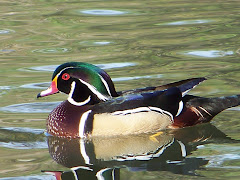
Wood Duck couple. Courtesy of US Fish and Wildlife Service--photographer Dave Menke.
I first saw this American duck at the Los Angeles Arboretum, but this beautiful duck is also a resident of Orange County as well. Since they are more wild than Mallards, you definitely won't find Wood Ducks hanging out in most neighborhood parks, but that doesn't mean they are above eating the bread and other junk food people toss out for the Mallards. Wood Ducks can be found in Irvine Regional Park, Craig Regional Park, and other places with wooded areas and streams and lakes. Wood Ducks do dabble like puddle ducks, but they also dive, and they perch in trees. It is this last ability that gets them into the classification "Perching Ducks." Wood Ducks are the only wild perching duck in Orange County. The two other Perching Ducks that can be found in Orange County are not wild. The Muscovy Duck either all white or partially black with some white is found in many parks and has some serious toe nails that help it cling to trees and other roosts. Most Muscovy ducks are descendants of domestic Muscovy Ducks which are white. The wild Muscovy Ducks are black. Both the domestic and the wild ducks have black or red warty-looking skin around the eyes. They are natives of Central and South America. The other perching duck is the Mandarin Duck which is a native of Asia. California has a small, feral population of Mandarin Ducks that appear sporadically at various parks, rivers, and streams in Orange County. Both these ducks are either escapees or descendants of escapees and are not native to Orange County. On the other hand, the Wood Duck is a wild, American duck, and a year-round Orange County resident that can be reliably found in several locations in Orange County.

Wood Duck drake crossing in front of Mallard hen at Irvine Regional Park in Orange, California.
The drake (or male) Wood Duck is brightly colored. He is bright green with iridescent purple with bold white markings on his face, a red bill with a yellow base, and red eyes. He has a large crest of green, white, and purple. He is a stand-out kind of drake. The female is gray and brown with a few white markings. She does have a few areas of purple iridescent sheen. She has a white horizontal tear drop surrounding each eye. She is sometimes confused with the female Mandarin Duck (an exotic escapee), but the tear-drop of white around the eye is diagnostic. See my post "Wood Duck or Mandarin Duck?"
 Wood Duck hen in the water at Irvine Regional Park in Orange, California. Notice the white tear drop around the eye.
 Wood Ducks eat acorns, pecans, and other nuts, seeds, aquatic invertebrates, insects, green plants, and fruits. From fruit to nuts, from pill bugs and snails to butterflies, there isn't much they won't eat. There is even a short blurb in journal about a Wood Duck who ate a mouse--but that is very rare. It is obvious why there are Wood Ducks in Irvine Regional Park. It is because there are so many trees, acorns, and so much water.

Their preferred habitat is wooded areas near streams, freshwater wetlands, ponds or lakes. But these areas must have food sources nearby or have plants in or near the water. This is no city bird. We see this species in parks containing woodlands, or with woodland areas nearby. Much habitat has been lost to development. And this is of concern.
 Wood Duck Drake preening at Irvine Regional Park in Orange, California.
The Wood Duck is a cavity nester. It makes its nest in tree cavities. So in addition to woodlands, lakes, streams, ponds, or any body of fresh water, the resident Wood Duck needs trees nearby with cavities in which it can nest. Since there has been so much loss of habitat, many types of conservationists from hunters (yes, most hunters are conservationists) to birders have been looking at what can be done to provide nesting habitat for Wood Ducks. Nesting boxes has been a very successful solution, and the nest boxes that people build for Wood Ducks have provided nesting cavities for thousands of ducks. The Wood Duck Society is an organization that provides nest boxes for these beautiful ducks. There is an Orange County Chapter of the Wood Duck Society. At least one local Orange County park with suitable habitat has Wood Duck nest boxes attached to its trees. I have seen Wood Ducks fly into the nest boxes, and I believe that they do nest in Orange County in nest boxes and in tree cavities.
 A handsome duck. Again I took this picture at Irvine Regional Park in Orange, California.
 Wood Ducks are seasonally monogamous. Not a big selling point for boyfriends or husbands, but pretty amazing for ducks in general. Wood Ducks have a courtship in which the flashy male shows off his crest and some mutual preening occurs. The hen finds a tree cavity or nest box lays up to 15 eggs. The male heads off to molt alone. So he misses the big show. The hen usually produces two broods a year. When nest boxes are placed too close together, hens sometimes lay eggs in each other's nests leading to harmfully high numbers of eggs in a nest. This over burdened nest is called a dump-nest, and is not a good thing for the ducks. So nest boxes are usually places far enough apart to discourage this behavior.
 Wood Duck hen courtesy of US Fish and Wildlife Service--Photographer Dave Menke. Notice the horizontal white tear drop around the eye.
 Breeding season is from January through April, but as late as June in some areas. The nest boxes and cavities can be quite high. Ducklings cannot fly like the mother and father can. Since the duckling must get out of the nest box and there is no ladder, they must jump sometimes hundreds of feet to the ground below. The mother stands on the ground and calls the ducklings. They respond, one by one by climbing up to the hole and jumping down. It looks like mass bungee jumping without the bungee as one duckling after the other jumps and bounces on the ground. Take a look below.
Three views of the ducklings jumping out of the nest: Inside the nest, from a distance, and over the exit. YouTube Video.
Although the longest living Wood Duck recorded was approximately 15 years old, most live only 3-4 years. They protect themselves by sleeping on the water. Their enemies are foxes, raccoons, snakes, and Great Horned Owls. It is a good thing the hen has so many ducklings because the mortality rate among Wood Duck ducklings is very high.

After Mallards, Wood Ducks are the most hunted ducks in the United States. Hunters, most of whom are conservationists, are very active in nesting box programs and other efforts to keep the populations high. Wood Ducks are not endangered.
 Male at Craig Regional Park in Fullerton.
You will find Wood Ducks from Southern Canada and south through Mexico. They breed as far south as Southern California. Lots of Wood Ducks come south to winter in Southern California and add to winter population.

Wood hen and drake swimming at Irvine Regional Park in Orange, California .
I love to go birding in areas with Wood Ducks. The lakes, streams, and the trees make for a quiet and restful walk. When you are birding in the OC or in L.A., check out the places below where Wood Duck have been seen. I doubt that you will be disappointed.
OC Birder Girl Links
Wood Duck or Mandarin Duck?
Where to Find Wood Ducks in Orange County and Los Angeles
(This is not an exhaustive list.)
Irvine Regional ParkWhere to Find Wood Ducks in Orange County and Los Angeles
(This is not an exhaustive list.)
Craig Regional Park
Yorba Regional Park
Descanso Gardens
Franklin Canyon
Los Angeles Arboretum

Wood Duck Drake flapping his wings. Courtesy US Fish and Wildlife Service--Photographer Dave Menke.
External Links and Resources
External Links and Resources
BirdWeb: Wood Duck
Informative Article from the Seattle Audubon Society.
California Waterfowl: Wood Duck Program
Details on the program which seeks to increase the number of Wood Ducks in California. Includes Wood Duck box instructions. Hunters are involved in this effort.
ConserveNature.org: Wood Duck
Good article from this New York website.
Hinterland Who's Who: Wood Duck
Nice article from Canadian site.
How to Build a Wood Duck Nest Box
Instructions on how to build a Wood Duck Nest Box.
Life History and Habitat Needs of the Wood Duck
Detailed information from USGS's Waterfowl Management Handbook.
Management of Wood Ducks on Private Lands and Waters
Good information on Wood Ducks and what they need.
STMA Schools: Wood Duck Cam
Wood Duck Cam clips in off season and live Cam in breeding season.
USGS: Wood Duck
Short, but helpful article. Also see their page on Wood Duck boxes.
Wood Duck Society
An organization over 100 years old that is all about Wood Ducks and nest boxes.
Journal Articles
Wilson Bulletin: Vol. 99, No. 4, October-December, 1987
North American Bird Bander: Vol. 3, No. 3, July-Septembers, 1978
American Kestrels Sit on Wood Duck Eggs
American Kestrels Sit on Wood Duck Eggs
Wilson Bulletin: Vol. 87, No. 4, October-December, 1975
Journal of Field Ornithology: Vol. 38, No. 3, July, 1967
Auk: Vol. 83, No. 2, April-June, 1966
Auk: Vol. 65, No. 3, July-September, 1948
Auk: Vol. 64, No. 4, October-December, 1947
Wilson Bulletin: Vol. 56, No. 3, July-September, 1944
uk: Vol. 54, No. 2, April-June, 1937
Condor: Vol. 26, No. 2, March-April, 1924


 Male
Male 


 Male
Male  Female