Lake at Irvine Regional Park.
(I am putting up some posts from last year that I was unable to finish and post. This is from 07/11/2009.)
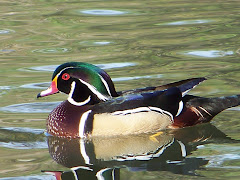
On Saturday I took a walk in Irvine Regional Park in Orange. There is something so relaxing about Irvine Regional Park. I parked by the lake and stopped to see which birds were at the lake. The ducks were swimming quietly by. All the drakes were in eclipse plumage. The Mallards and Wood Duck drakes where decked out in plumage that was very different from their usual flashy feathers.
On Saturday I took a walk in Irvine Regional Park in Orange. There is something so relaxing about Irvine Regional Park. I parked by the lake and stopped to see which birds were at the lake. The ducks were swimming quietly by. All the drakes were in eclipse plumage. The Mallards and Wood Duck drakes where decked out in plumage that was very different from their usual flashy feathers.

Mallard drake (male) in eclipse plumage looking similar to the female Mallard. You can tell he is a male by his yellow bill with no black on it and the brown patterns on his chest and sides. The feathers on his chest and sides are tipped with a chestnut brown color. The males also have a little curl in their tail feathers, but that is not diagnostic since in molting, they often lose those curly tail feathers.

Female Mallard. Diagnostic field marks: Orange bill with black on top.

Another female Mallard. Note the black on her orange bill.
Mallard drakes in eclipse plumage look very much like Mallard hens. The difference is subtle. A female Mallard has an overall brown appearance and an orange bill that has a lot of black on the upper mandible. However, the male while also brown, has patterned chestnut sides and chest and a yellow bill without any black. Although the male also has curled tail feathers, they are often lost in the change from breeding plumage to eclipse plumage and the change back to breeding plumage. So curly tail feathers are not a reliable field mark for male Mallards.
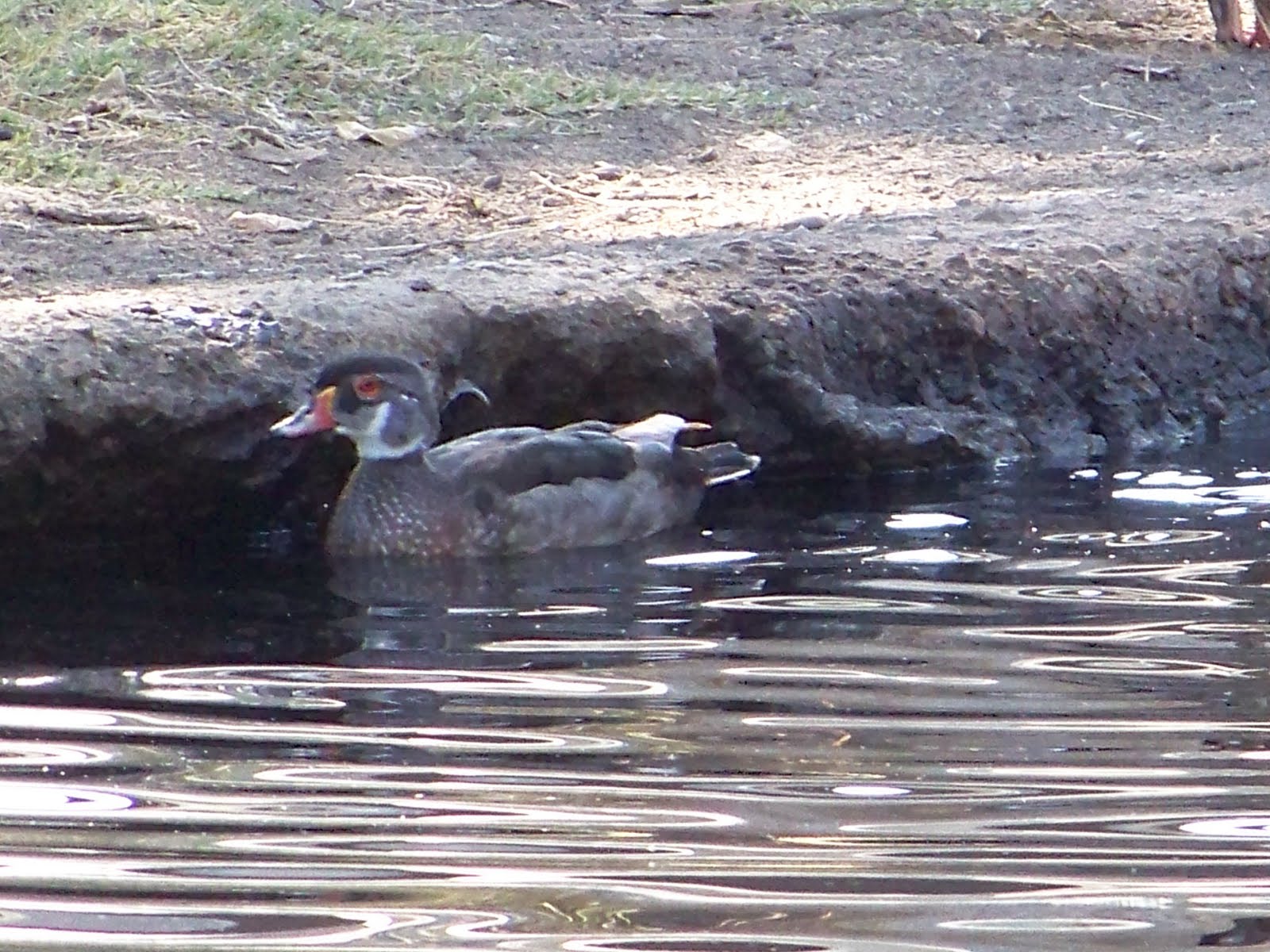
Wood Duck drakes undergo an even more extreme change. Not only is there a change in color, but he loses his beautiful crest. He looks drabber and a bit odd.


Coastal live oak in Irvine Regional Park
In spite of all its amenities including a children's railroad, pony rides, playgrounds, and the zoo, Irvine Regional Park is full of native plants, trees, birds and other animals. The Oak Woodlands that cover much of the main park are quintessential Southern California. Their dark branches twist and turn, and let a little light through to light up the areas under them. They provide food and shelter for the birds and other animals who live and migrate through Orange County. Squirrels, woodpeckers, nuthatches, and Wood Ducks are among the animals that use the coastal live oaks for food and shelter. Also found among the coastal live oaks in the oak woodlands are California sycamore, California black walnut, cottonwood trees, and pine trees. Great oak woodlands can be found in many other areas of Orange County such as Santiago Oaks, Oak Canyon Nature Center, O'Neill Park, and many other parks and natural areas.
 California Black Walnut shells.
 California black walnuts have a much smaller amount of meat than the walnuts you find in the store, and the shells are very hard, but they were used as food and money by the Native Americans who lived in Southern California. California black walnut trees can be shrub-like or they can be trees up to 30 feet tall. You will find them in many places in Orange County and in Southern California.
 Here is a California black walnut still on the tree. The leaves are distinctive.
 A large California black walnut tree.
Birds that eat the nut meats from the California black walnut are towhees, grosbeaks, finches, thrashers, titmice, and crows.
 Bewick's Wren--one of several wren species in the park.
By a leaky sprinkler there were Bewick's Wrens, Bullocks Orioles, Anna's Hummingbirds, Lesser Goldfinches, and lots of other little birds. Water is a big draw for birds of all kinds. Even something as small as a little leaky sprinkler becomes a busy watering hole. The nearby wagons and trees became perches for the birds as they checked the area out for predators before going down for a drink.
 Bewick's Wren on the wagon wheel.
 Old wagons and a sprinkler leaking.
Acorn Woodpecker on phone pole being used as a granary tree.
I walked over by the zoo to catch a look at the Acorn Woodpeckers that have turned a telephone pole into a granary tree filled with acorns. And also to check out the flowers for hummingbirds and butterflies.

Western Tiger Swallowtail.
Over by the zoo are California fuschia and other plants that attract butterflies and hummingbirds. I could not get a clear picture of the hummers, but did get a few of a Western Tiger Swallowtail.

This was one noisy male Peacock.
Peacocks can be found anywhere in Irvine Regional Park, but they are found especially by the horses and the zoo. They are not native species, but can be found in the hills around the City of Orange. Peacocks aka Peafowl have been raised by people in Southern California over the years and are periodically released or escape. There are colonies in several Southern California areas such as Palos Verdes Estates, the City of Orange, and Arcadia. In spring and summer, they call loudly looking for mates sounding like a cat on steroids. It can be unnerving. As this Peacock shrieked, a small boy, hands over his ears, implored his mother and grandmother to "Make it stop!" He was frightened. His mom explained the Peacock was looking for the mother peacock which somewhat mollified the boy, but he still looked relieved to be moving away from the caterwauling peacock toward the zoo entrance.
 Going back for another splash in the lake.
The strangest thing I saw was a Western Kingbird flycatching insects off the surface of the lake. It would swoop down and splash into the water. Then it would go up in the tree to dry off, and then do the whole thing again.

I walked over by the zoo to catch a look at the Acorn Woodpeckers that have turned a telephone pole into a granary tree filled with acorns. And also to check out the flowers for hummingbirds and butterflies.

Western Tiger Swallowtail.
Over by the zoo are California fuschia and other plants that attract butterflies and hummingbirds. I could not get a clear picture of the hummers, but did get a few of a Western Tiger Swallowtail.

This was one noisy male Peacock.
Peacocks can be found anywhere in Irvine Regional Park, but they are found especially by the horses and the zoo. They are not native species, but can be found in the hills around the City of Orange. Peacocks aka Peafowl have been raised by people in Southern California over the years and are periodically released or escape. There are colonies in several Southern California areas such as Palos Verdes Estates, the City of Orange, and Arcadia. In spring and summer, they call loudly looking for mates sounding like a cat on steroids. It can be unnerving. As this Peacock shrieked, a small boy, hands over his ears, implored his mother and grandmother to "Make it stop!" He was frightened. His mom explained the Peacock was looking for the mother peacock which somewhat mollified the boy, but he still looked relieved to be moving away from the caterwauling peacock toward the zoo entrance.

The strangest thing I saw was a Western Kingbird flycatching insects off the surface of the lake. It would swoop down and splash into the water. Then it would go up in the tree to dry off, and then do the whole thing again.

Drying off.


 Female (hen) with male (drake)