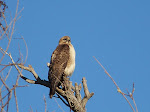
A Red-Tailed Hawk by the Muth Center at the Upper Newport Bay Ecological Reserve. The Mature Red-tail's long wings often hide the red tail when perched.
I received a question about a week ago and am sorry for the delay. I have been struggling with an injury and moving a bit slowly on all fronts. So, enough excuses, your hawk question.
Question:
"I saw a pair of huge scruffy chocolate-brown hawks in Huntington Central Park the week before last. In flight, their undersides reminded me of red tails - that dark leading edge of the wing and barred tail - but these birds were uniformly dark on the breast, upper parts and sides. No rufous, no white visible when perched, no red in the tail. Their calls were a bit like the Harris's hawk on whatbird.com and not at all like the typical red tail call. New to birding and a bit baffled - any ideas? Do various hawk species ever hybridize?"
 Same Red-Tailed Hawk.
Red-Tailed Hawks have the most varied plumage of hawks and of most other birds as well. They can be light, dark, rufous, albino, leucistic, and anywhere in-between. Immatures do not have a red tail and have very light barring across the tail. If you see thick, dark barring, you are not looking at a Red-Tail. Smaller than Red-tails, both Red-Shouldered Hawks and Cooper's Hawks have darker, thicker barring on their tails, and the Red-shouldered has the thickest, most contrasting black-and-white barring and additional thick black-and-white barring on the underside of its wings. Because Red-tails have long wings, the red tail is often not visible even in mature birds when perched. No other hawk has the Red-tail's characteristic dark leading edge on the underside of the wing, nor do they have the belly band. The USGS: Red-tailed Hawks talks about several types of plumage on Red-tails. Worth a look. Take a look also at this page from the Birds of Orange County: Red-Tailed Hawk and notice the different plumages that show up just in Orange County. Other great discussions of the much discussed plumage variations: All About Birds: Red-tailed Hawk, Dark Red-tailed Hawks, and Avian Web: Red-tailed Hawks. In addition, the Virtual Birder has a Hawks in Flight Gallery. You can pick raptors to compare and see if anything looks like what you saw. Keep in mind they don't have every plumage of Red-tailed Hawk. The Harris's Hawk has terminial white tip in all plumages.
 Adult Red-tailed Hawk in flight.
Immature Red-tailed Hawk
 Immature Red-Tailed Hawk. Click on the picture to enlarge and see the black leading edge of the shoulder wing area and the light belly band--no other hawk has these that I know.
 Sounds of Red-Tailed Hawks vs Cooper's Hawks and Red-Shouldered Hawks vs Harris's Hawk
The Red-tailed Hawk has several different calls depending on the circumstances and age of the hawk. There is the typical screaming type of call that we are all familiar with whether we know it or not through movies and TV. There are also scolding calls, mating calls, and sounds made by nestlings. Check these links to hear a variety of calls: All About Birds: Red-tailed Hawk Sounds, Animal Diversity Web: Red-tailed Hawk Sounds, BirdWeb: Red-tailed Hawk, and San Diego Zoo: Red-tailed Hawk. While the Red-tail scream is the best known hawk or eagle sound, it is not the only sound that Red-tails make. So don't judge by the scream. Compare and note that the Harris's Hawk's normal call and the Red-tail's scolding are very similar.
 Harris's Hawk at San Diego Wild Animal Park. Dark brown with terminal white markings on tails of mature and immature.
The Cooper's Hawks and Red-Shouldered Hawks are a lot more noisy than the Red-tailed Hawk and will sit and call and call. The Red-Shouldered Hawk in particular is often noticed because it is calling all the time. Here is a link to All About Birds: Red-Shouldered Hawk Sounds. Here is a link to several types of Cooper's Hawk calls at All About Birds: Cooper's Hawk Sounds. Hear Harris's Hawk here at All About Birds: Harris's Hawk.
Orange County has many Hawks and you will find many in Huntington Central Park including Red-Tailed Hawks, Red-Shouldered Hawks, Cooper's Hawks, the occasional Sharp-shinned Hawk, and on rare occasions other hawks as well. Red-tailed Hawks are the largest hawks, followed by the Red-shouldered, and then the Cooper's Hawk.

I have seen a scruffy-looking immature Red-Tailed Hawk in Huntington Central Park on several occasions recently so I would not be surprised if that is what you saw. I have also seen Cooper's Hawks and Red-Shouldered Hawks at Huntington Central Park. Study your raptors and keep your binoculars ready for hawks fying overhead and resting in trees.
Links
Birds of Orange County
Raptor rescue organization in Orange County.
Check for rare bird sightings.
Orange County Birding--Yahoo Group
Check for rare and unusual sightings, ask other birders for advice finding a species, etc.