Sunday, February 10, 2008

Loggerhead Shrike--Lanius ludovicianus

Loggerhead Shrike Courtesy of US Fish and Wildlife Service. Photographer--Dave Menke. Cute and lethal.


The sharp-eyed Loggerhead Shrike is a predatory songbird. It is not just a pretty face, but a predator that eats insects, rodents, reptiles, amphibians, and smaller birds. It will also eat road kills and carrion. Its hooked beak has bristles at the base like a flycatcher. It uses that strong beak to kill its prey. It is frequently referred to as an "opportunistic predator" because of the large range of possible meals on its menu. The species is widely known by the nickname "Butcher Bird" due to their habit of hanging killed prey on thorns or fences. Why the macabre behavior? Several have been suggested: marking its territory, attracting a mate, aging toxic prey to degrade the toxins, using the thorns to assist in tearing apart its prey, or storage of leftovers. All may be reasons for this behavior. Whatever the reason it has hung the prey you see, a hanging mouse or other prey can mean you have entered a Loggerhead Shrike's territory.

Loggerhead Shrike.  Photographer Karen McQuade.  Copyright


This stocky little songbird is similar in coloring to the more slender Mockingbird. Unlike the Mockingbird, Loggerhead Shrike sports a black mask over its eyes. Because it has songbird feet, not talons, it secures its the prey by thorns and forked branches.  Then the shrike uses its strong bill to tear up its prey. The Loggerhead Shrike's songs sound like moderately musical tweets, whistles, and buzzy, loud calls. It is about the size of an American Robin. It can be differentiated from the Mockingbird by its stocky build, its mask, dark, hooked bill, darker wings in flight, and dark eyes. The immature Loggerhead Shrike is duller and has very light barring across the back and the chest. The Mockingbird has yellow eyes. The Loggerhead Shrike is similar to the larger Northern Shrike which is rarely--if ever-- seen in Orange County. I have searched the Orange County Rare Bird Alert and have not found one record of a Northern Shrike in Orange County.


Loggerhead Shrike Courtesy of US Fish and Wildlife Service. Photographer--Gary Stoltz.


Habitat of the Loggerhead Shrike has two very important things: grasslands including pastureland, and low trees or low shrubs to perch on and watch for prey in the grasslands. Other places are fallow fields and railroad right-of-ways. Thorny bushes or trees are a plus. They often build nests in sagebrush. Their nests may not be very inviting for brown-headed cow birds which parasitize many species. A tough predator like the Loggerhead Shrike could easily take down the cowbird. Loggerhead Shrikes are not seasonally monogamous. They raise two broods or more in a season with either the same or different mates. Females are most likely to leave the male caring for their brood while she goes off and has another brood. Multiple broods are more likely in southern areas of its range such as Southern California. The lifespan of a Loggerhead Shrike is a few years with the longest being an unusual 6 years old.


Loggerhead Shrike at San Jacinto Wildlife Area.  Photographer Karen McQuade.  Copyright.

Loggerhead Shrikes nest in Canada, Washington and south to California, Wisconsin, Minnesota, Michigan, Maryland, and Florida. The breeding range looks spotty on the map. Loggerhead Shrikes return to breeding grounds starting in February and continue to arrive through May. By August, they are heading back to their wintering grounds. In Orange County, although we have Loggerhead Shrikes year round, they are almost rare.


Short YouTube Video of Loggerhead Shrike nestlings that have fledged, begging for food.


Populations of Loggerhead Shrikes have declined 71% in the last 40 years. Since I started birding in 1982, I have noticed the decline in Orange County. Pesticides are one factor. In addition, current farming practices clear fields of trees so large machinery can be used, and thus the Loggerhead Shrike's perching trees and shrubs in agricultural fields are disappearing. They like to catch insects flushed out by farm machinery, but Orange County farmland of any kind is disappearing fast due to its conversion to housing subdivisions. Loggerhead Shrikes need land and that is exactly what is shrinking as we all crowd in to areas that used to be farmland. Check out Riverside County near Hemet if you want to see farmland disappearing in Southern California. It is hard to find Loggerhead Shrikes in Orange County with its housing-and-mall sprawl. There was a time when on the way to work I would pass miles and miles of farmland and stop at the Irvine Ranch Market for fruits and vegetables. No more. I did see a lone Loggerhead Shrike just recently at Bolsa Chica Ecological Reserve though. It was great to see the gray-and-black masked song bird sitting on a post. Interestingly, he was near a dead bush that may have had thorns. I haven't see the masked bird in a long time.


Loggerhead Shrike.  Photographer Karen McQuade.  Copyright.

The best thing to do if you want to see a Loggerhead Shrike in Orange County is to look in areas where Loggerhead Shrikes have been seen and in areas that provide the low grassland habitat with a few perches that would attract them. A thorny bush or two nearby wouldn't hurt. So when you are out birding in Orange County, keep an eye out for this masked bird. The Loggerhead Shrike may be perched on a post, dead tree, or fence near you.


Loggerhead Shrike.  Photographer Karen McQuade.  Copyright.


Places you might see a Loggerhead Shrike


Orange County

Uncommon -- Bolsa Chica Ecological Reserve

Uncommon -- Huntington Beach

Unknown Frequency -- San Joaquin Wildlife Sanctuary

Uncommon -- Seal Beach National Wildlife Refuge

Breeds --Starr Ranch Sanctuary


Uncommon--Upper Newport Bay


Other Areas

Breeding Resident -- San Diego County


unknown frequency -- Santa Barbara


unknown frequency -- San Bernardino County


unknown frequency --Riverside County


Common Spring, Summer, Fall/Uncommon in Summer--Ventura County

(Source Audubon Society 2007 Birds of Ventura County.)


OC Birder Girl Links


Birding Hot Spots in Orange County, California


Bolsa Chica Ecological Reserve


San Joaquin Wildlife Sanctuary


External Links and Resources


All About Birds: Loggerhead Shrike Lanius ludovicianus

Detailed article about the Loggerhead Shrike includes appearance, behaviors, range, diet, and habitat.


Animal Diversity Website: Loggerhead Shrike

Lots of details from this University of Michigan site includes appearance, diet, range, reproduction, behaviors, and lots more.


Birder's World: Identification, range, habits, and conservation of the Loggerhead Shrike

Detailed article regarding conservation of the Loggerhead Shrike and its threatened habitat.


BirdWeb: Loggerhead Shrike

Another good Seattle Audubon article. This article on the Loggerhead Shrike gives detailed information on the little predatory songbird.


Chipperwood Bird Observatory: The Loggerhead Shrike

Great article with lots on nesting habits and photos of Loggerhead Shrike nestlings.


Common Bird in Decline Loggerhead Shrike

Audubon Society page on the concerns regarding the decline of this species and what steps can be taken to reverse this trend.


Effects of Management Practices on Grassland Birds: Loggerhead Shrike

Detailed article about the Loggerhead Shrike and the effect of habitat management on the species in the United States.


Effects of Habitat Structure on Patch Use by Loggerhead Shrikes Wintering in a Natural Grassland

(Condor: Vol. 96, No. 1, January-February, 1994)


Internet Bird Collection: Lanius ludovicianus Loggerhead Shrike

Videos of the Loggerhead Shrike. Very good quality videos.


Loggerhead Shrike Fact Sheet

Great fact sheet from New York State.


Loggerhead Shrikes, Red Fire Ants and Red Herrings?

Are aggressive non-native red fire ants causing a decline in Loggerhead Shrikes.
REWEN YOSEF AND FRED E. LOHRER take a look at the relationship of the predator and the ants. (Condor: Vol. 97, No. 4, July-August, 1995)


National Park Service Channel Islands: Loggerhead Shrike

Article on the the Loggerhead Shrike in the Channel Islands just off the coast of Southern California. Short.


Nesting Habits of the Loggerhead Shrike in Sagebrush

(Condor: Vol. 98, No. 1, January-February, 1996)


San Clemente Loggerhead Shrike Captive Breeding Program

Subspecies on San Clemente Island (the most southern-lying of the Channel Islands) is in danger of extinction and an attempt at a captive breeding program is having some success. San Clemente Island is located off the coast of Southern California near San Diego.


Species Profile: Loggerhead Shrike (Lanius ludovicianus) on Military Installations
in the Southeastern United States


Detailed report on the Loggerhead Shrike.


The Strange World of the Shrike

An article about Shrikes in general. (NATIONAL WILDLIFE MAGAZINEFeb/Mar 2000, vol. 38 no. 2)


USGS: Loggerhead shrike Lanius ludovicianus

Short, but good article.


Yikes, it's a shrike! --From Ranger Rick Magazine
From BNet a great Ranger Rick Article. Funny article filled with facts about Shrikes.


Home - Index - Contact - Shop -


Ask the OC Birder Girl -


OC Birder Girl Videos

Sunday, February 3, 2008

Wood Duck--Aix sponsa

Wood Duck couple. Courtesy of US Fish and Wildlife Service--photographer Dave Menke.

I first saw this American duck at the Los Angeles Arboretum, but this beautiful duck is also a resident of Orange County as well.  Since they are more wild than Mallards, you definitely won't find Wood Ducks hanging out in most neighborhood parks, but that doesn't mean they are above eating the bread and other junk food people toss out for the Mallards.  Wood Ducks can be found in Irvine Regional Park, Craig Regional Park, and other places with wooded areas and streams and lakes. Wood Ducks do dabble like puddle ducks, but they also dive, and they perch in trees. It is this last ability that gets them into the classification "Perching Ducks."  Wood Ducks are the only wild perching duck in Orange County.  The two other Perching Ducks that can be found in Orange County are not wild.  The Muscovy Duck either all white or partially black with some white is found in many parks and has some serious toe nails that help it cling to trees and other roosts.   Most Muscovy ducks are descendants of domestic Muscovy Ducks which are white.  The wild Muscovy Ducks are black.  Both the domestic and the wild ducks have black or red warty-looking skin around the eyes.  They are natives of Central and South America.  The other perching duck is the Mandarin Duck which is a native of Asia.  California has a small, feral population of Mandarin Ducks that appear sporadically at various parks, rivers, and streams in Orange County.   Both these ducks are either escapees or descendants of escapees and are not native to Orange County.  On the other hand, the Wood Duck is a wild, American duck, and a year-round Orange County resident that can be reliably found in several locations in Orange County.


Wood Duck drake crossing in front of Mallard hen at Irvine Regional Park in Orange, California.

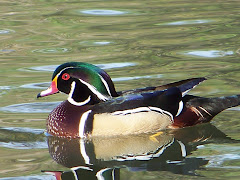
The drake (or male) Wood Duck is brightly colored. He is bright green with iridescent purple with bold white markings on his face, a red bill with a yellow base, and red eyes. He has a large crest of green, white, and purple. He is a stand-out kind of drake. The female is gray and brown with a few white markings. She does have a few areas of purple iridescent sheen. She has a white horizontal tear drop surrounding each eye. She is sometimes confused with the female Mandarin Duck (an exotic escapee), but the tear-drop of white around the eye is diagnostic.  See my post "Wood Duck or Mandarin Duck?"

Wood Duck hen in the water at Irvine Regional Park in Orange, California. Notice the white tear drop around the eye.


Wood Ducks eat acorns, pecans, and other nuts, seeds, aquatic invertebrates, insects, green plants, and fruits. From fruit to nuts, from pill bugs and snails to butterflies, there isn't much they won't eat. There is even a short blurb in journal about a Wood Duck who ate a mouse--but that is very rare. It is obvious why there are Wood Ducks in Irvine Regional Park. It is because there are so many trees, acorns, and so much water.


Their preferred habitat is wooded areas near streams, freshwater wetlands, ponds or lakes. But these areas must have food sources nearby or have plants in or near the water. This is no city bird. We see this species in parks containing woodlands, or with woodland areas nearby. Much habitat has been lost to development. And this is of concern.


Wood Duck Drake preening at Irvine Regional Park in Orange, California.

The Wood Duck is a cavity nester. It makes its nest in tree cavities. So in addition to woodlands, lakes, streams, ponds, or any body of fresh water, the resident Wood Duck needs trees nearby with cavities in which it can nest.  Since there has been so much loss of habitat, many types of conservationists from hunters (yes, most hunters are conservationists) to birders have been looking at what can be done to provide nesting habitat for Wood Ducks. Nesting boxes has been a very successful solution, and the nest boxes that people build for Wood Ducks have provided nesting cavities for thousands of ducks. The Wood Duck Society is an organization that provides nest boxes for these beautiful ducks. There is an Orange County Chapter of the Wood Duck Society. At least one local Orange County park with suitable habitat has Wood Duck nest boxes attached to its trees.  I have seen Wood Ducks fly into the nest boxes, and I believe that they do nest in Orange County in nest boxes and in tree cavities.

A handsome duck. Again I took this picture at Irvine Regional Park in Orange, California.

Wood Ducks are seasonally monogamous.   Not a big selling point for boyfriends or husbands, but pretty amazing for ducks in general.  Wood Ducks have a courtship in which the flashy male shows off his crest and some mutual preening occurs. The hen finds a tree cavity or nest box lays up to 15 eggs. The male heads off to molt alone. So he misses the big show. The hen usually produces two broods a year. When nest boxes are placed too close together, hens sometimes lay eggs in each other's nests leading to harmfully high numbers of eggs in a nest. This over burdened nest is called a dump-nest, and is not a good thing for the ducks.   So nest boxes are usually places far enough apart to discourage this behavior.

Wood Duck hen courtesy of US Fish and Wildlife Service--Photographer Dave Menke. Notice the horizontal white tear drop around the eye. 

Breeding season is from January through April, but as late as June in some areas. The nest boxes and cavities can be quite high.  Ducklings cannot fly like the mother and father can.   Since the duckling must get out of the nest box and there is no ladder, they must jump sometimes hundreds of feet to the ground below. The mother stands on the ground and calls the ducklings. They respond, one by one by climbing up to the hole and jumping down. It looks like mass bungee jumping without the bungee as one duckling after the other jumps and bounces on the ground. Take a look below.

Three views of the ducklings jumping out of the nest: Inside the nest, from a distance, and over the exit. YouTube Video.

Although the longest living Wood Duck recorded was approximately 15 years old, most live only 3-4 years. They protect themselves by sleeping on the water. Their enemies are foxes, raccoons, snakes, and Great Horned Owls. It is a good thing the hen has so many ducklings because the mortality rate among Wood Duck ducklings is very high.
After Mallards, Wood Ducks are the most hunted ducks in the United States. Hunters, most of whom are conservationists, are very active in nesting box programs and other efforts to keep the populations high. Wood Ducks are not endangered.
Male at Craig Regional Park in Fullerton.

You will find Wood Ducks from Southern Canada and south through Mexico. They breed as far south as Southern California.   Lots of Wood Ducks come south to winter in Southern California and add to winter population.


Wood hen and drake swimming at Irvine Regional Park in Orange, California .     

I love to go birding in areas with Wood Ducks.   The lakes, streams, and the trees make for a quiet and restful walk.  When you are birding in the OC or in L.A., check out the places below where Wood Duck have been seen.  I doubt that you will be disappointed.

OC Birder Girl Links
Wood Duck or Mandarin Duck?


Where to Find Wood Ducks in Orange County and Los Angeles
(This is not an exhaustive list.)


Irvine Regional Park


Craig Regional Park


Yorba Regional Park


Descanso Gardens


Franklin Canyon


Los Angeles Arboretum


Wood Duck Drake flapping his wings. Courtesy US Fish and Wildlife Service--Photographer Dave Menke.


External Links and Resources


Animal Diversity Website: Wood Duck

Thorough article written by students at Michigan State.


BirdWeb: Wood Duck

Informative Article from the Seattle Audubon Society.


California Waterfowl: Wood Duck Program

Details on the program which seeks to increase the number of Wood Ducks in California. Includes Wood Duck box instructions. Hunters are involved in this effort.


ConserveNature.org: Wood Duck

Good article from this New York website.


Hinterland Who's Who: Wood Duck

Nice article from Canadian site.


How to Build a Wood Duck Nest Box

Instructions on how to build a Wood Duck Nest Box.


Life History and Habitat Needs of the Wood Duck

Detailed information from USGS's Waterfowl Management Handbook.


Management of Wood Ducks on Private Lands and Waters

Good information on Wood Ducks and what they need.


STMA Schools: Wood Duck Cam

Wood Duck Cam clips in off season and live Cam in breeding season.


USGS: Wood Duck

Short, but helpful article. Also see their page on Wood Duck boxes.


Wood Duck Society

An organization over 100 years old that is all about Wood Ducks and nest boxes.


Journal Articles
Wilson Bulletin: Vol. 99, No. 4, October-December, 1987
North American Bird Bander: Vol. 3, No. 3, July-Septembers, 1978


American Kestrels Sit on Wood Duck Eggs

Wilson Bulletin: Vol. 87, No. 4, October-December, 1975
Journal of Field Ornithology: Vol. 38, No. 3, July, 1967
Auk: Vol. 83, No. 2, April-June, 1966
Auk: Vol. 65, No. 3, July-September, 1948
Auk: Vol. 64, No. 4, October-December, 1947
Wilson Bulletin: Vol. 56, No. 3, July-September, 1944
uk: Vol. 54, No. 2, April-June, 1937
Condor: Vol. 26, No. 2, March-April, 1924

American Bittern--Botaurus lentiginosus--A Rare Bird

American Bittern courtesy of US Fish and Wildlife Service.


I have seen an American Bittern once. It was while birding at El Dorado Nature Center in Long Beach, California on 11/24/2008--it's written in my field guide. My best friend Gloria, my husband at the time, and I went to El Dorado Nature Center. My friend Gloria and I wanted to see as many birds as we could and scanned the areas around the paths for birds. My ex wanted to see the most unusual bird there and set out to carefully examine every likely place the American Bittern might be hiding. Since it has markings that look like marsh reeds and grasses, and freezes with its bill pointed upward also looking like a reed, it is perfectly camouflaged. A very hard bird to spot. It is active from dusk to dawn. We went early and were the first ones through, and sure enough, he spotted an American Bittern. My ex was kind enough to point it out as we had pointed out the Black-crowned Night Herons, the Green Heron, a "Common Egret"--now a Great Egret--the Loggerhead Shrike, and all the other birds Gloria and I spotted and identified that day. But the prize went to Ross who carefully examined every marshy area until he found an American Bittern. Thanks to him, we saw it, too. It was in the reeds, striking that beak-in-the-air pose. It was something to see.


American Bittern courtesy of US Fish and Wildlife Service.


The American Bittern is in the same family as Herons and Egrets. It is sometimes referred to as a heron. It has a long, relatively thick neck for a heron and a long, powerful bill. It has long, brown patterned markings on its thick, long neck that allow it to easily blend in with reeds and grasses in marshes and wetlands. It is such a successful camouflage that most people miss it as we almost did. The camouflage is great for the secretive American Bittern, but sad for those of us who want to see the long-necked bird. The best clue that it is near is the pump-like sound described variously as "glunk-a-chunk," "oonck-a-tsoonck" (Golden Field Guide to North American Birds), "bloonk-adoonk" (Sibley), "pump-er-lunk" (Audubon Guide to North American Birds) "oonk-a-lunk" (National Geographic Guide to North American Birds), "pump-er-wink"(State of Connecticut site), "oong-ka-choonk" (Cornell's All About Birds). It sounds very guttural and almost mechanical--like a pump or the thud of a stake being hit. If you are in a marsh or wetlands and hear that sound, look carefully among the reeds. You may have to move closer because the American Bittern's voice carries some distance. Check out the Nancy Today video below and hear her imitation of the American Bittern. It is pretty funny--and sounds about right.


American Bittern courtesy of US Fish and Wildlife Service.

American Bitterns are inhabitants mostly of fresh water marshes and wetlands. But it is seen in Bolsa Chica and Upper Newport Bay which both have salt water areas in which the American Bittern can be seen. The American Bittern is a very elusive bird so count yourself a lucky birder if you spot it. It moves slowly and silently.


This is Canadian Nancy Today who is pretty funny. You won't forget how an American Bittern sounds. Nancy is a free-lance writer.

It's a bird that is a loner out in the wetlands or marshes in which it lives. A very solitary bird. No flocking together or nesting together. It likes to be alone in the marsh. Likes to wander through the Wetlands. American Bitterns eat fish, frogs, crayfish, insects--including dragon flies-- small snakes and eels, and small mammals.


Nancy observing American Bitterns--you can really tell that it is hard to spot American Bitterns. Nancy's other videos range from funny to informative.

The courtship of the American Bittern has been described over the years a few authors and even diagrammed by ornithologist Paul A. Johnsgard. The American Bittern is generally monogamous. The male has white "nuptial plumes" that are on its shoulder. It can fan them out when displaying to the female. Quite a display evidently.


American Bittern foraging among the reeds in a marsh from YouTube.


Most maps show that Orange County is an area for wintering American Bitterns. There is a small area north of us along the coast that shows year-round American Bitterns. Even though a bird only winters in an area, there is a chance of non-breeding birds remaining behind. They are listed as rare in winter and fall in Bolsa Chica. (Check out this picture on Flicker of an American Bittern at Bolsa Chica.) It is listed in Huntington Beach in General as rare year-round. It can be found at San Joaquin Wildlife Sanctuary (Here are some pictures at SJWS by Glenn Price), but they do not say which seasons. Seal Beach National Wildlife Refuge lists them rare in every season except summer in which they are absent. The Upper Newport Bay census does not show them at all, but sightings have been reported to the OC Rare Bird Alert. San Diego Museum of Natural History shows the American Bittern as a bird that winters and occasionally breeds in San Diego County. The species has also bred in Santa Barbara, and Ventura lists it as rare to very rare.


American Bittern in a pond from YouTube.

An American Bittern can be confused with two immature birds: Black-Crowned Night Heron and the Green Heron. The American Bittern is has a larger, sharper bill than either and more defined, warmer striping. It has a longer and wider neck. It does hunch up as well. The characteristic pose with its bill in the air is like no other. The sound is different as well.

To have the best chance of seeing American Bitterns you would need to go birding in the northern states like Washington, Michigan, Maine, and the like. Or to Canada. To have a chance of seeing the wintering American Bittern in Orange County, do what my ex did: go to the habitat they like, go early or at dusk, and look very closely. I would also say, listen for the pumping call and see if you can find it. Birding in Orange county is a fun outdoor sport when you are looking for rare birds. So if you Orange County birders want to see an American Bittern, get out there in the wetlands and marshes in fall and winter, and look sharp. You just might add it to your life list.


Where can a birder possibly see American Bitterns?

Bolsa Chica Ecological Reserve

Upper Newport Bay

Talbert Marsh

El Dorado Nature Center in Long Beach


Seal Beach National Wildlife Refuge


OC Birder Girl Links


Bolsa Chica Ecological Reserve


Orange County Bird Checklists


San Joaquin Wildlife Sanctuary


Black-crowned Night Heron--Nycticorax nycticorax


Cattle Egret--Bubulcus ibis--A Rare Bird


Great Blue Heron--Ardea herodias


Great Egret--Ardea alba


Green Heron--Butorides virescens


The Herons and Egrets of Orange County


Reddish Egret--A Rare Bird


Snowy Egret--Egretta thula


Upper Newport Bay Ecological Reserve aka Newport Back Bay


External Links and Resources


The American Bittern as a Stake-driver

This is an article (Auk: Vol. 57, No. 4, October-December, 1940) discussing the varying sound of the American Bittern and if it is distance that makes it sound different to the listener. You must page down a little to see it.


American Bittern Habitat Model

Short summary of habitat needs of the American Bittern.


Animal Diversity Web: American Bittern

Detailed information on this secretive bird.


Audubon Society: #15 Common Bird in Decline American Bittern (Botaurus lentiginosus)

About the American Bittern's decreasing numbers.


Bird Cinema: American Bittern

Videos on Bird Cinema that show the American Bittern.


Birds of North America: American Bittern

Courtesy preview of a much longer section covering the American Bittern. Some good information.


BirdWeb: American Bittern

Good article from the Seattle Audubon Society.


California Wildlife Habitat Relationships System

A fact sheet.


The Courtship Display of the American Bittern

Field Observation of the courtship of two American Bitterns observed by the author William G. Fargo and written up in Auk: Vol. 45, No. 2, April-June, 1928.


On the Courtship of the American Bittern

A short description of a field observation of the courtship of the American Bittern from Condor: Vol. 31, No. 2, March-April, 1929.


Copulatory Behavior of the American Bittern

Another description of the courtship of the American Bittern with field drawings. (Auk: Vol. 97, No. 4, October-December, 1980)


Effects of Management Practices on Grassland Birds:
American Bittern


Paper on the effects of human management of grasslands and wetlands and how it affects the American Bittern. Areas include California.


Internet Bird Collection: American Bittern

Great video of an American Bittern by videographer and birder Don Des Jardin


National Audubon Society: American Bittern

Good information in this Audubon article on the American Bittern.


NatureWorks: American Bittern - Botaurus lentiginosus

Nice article.


Saltgrass Flats: American Bittern

Nice photos from this Texas site.


USGS: American Bittern

Short, but good article.


Visual Resources for Ornithology: American Bittern

Pictures of the American Bittern


Home - Index - Contact - Shop -


Ask the OC Birder Girl -


OC Birder Girl Videos