American White Pelicans showing their black wing tips. Photo courtesy of the US Fish and Wildlife Service.
American White Pelicans are big water birds with black wing tips and a very large bill with a pouch. During breeding season, the top of the bill sports a flat growth of the same orange color as the bill. American White Pelicans have a wingspan of 9 feet and stand about 4 feet tall. There are 7 species of Pelican world-wide and only two in the United States. Both American White Pelicans and Brown Pelicans are are found in Orange County, California. Both visit in the Fall and Winter.

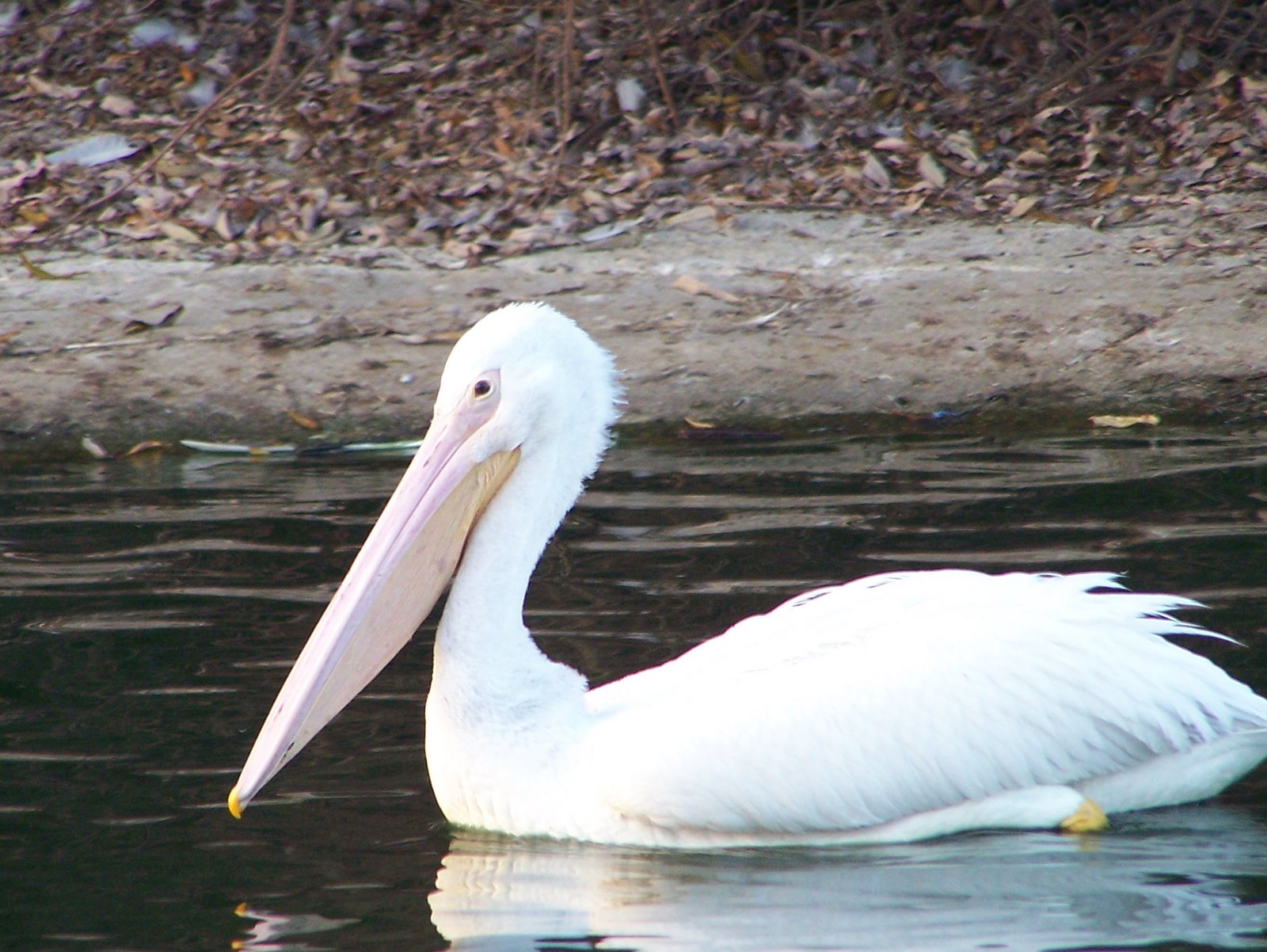
American White Pelican at Carr Park in Huntington Beach.
American White Pelicans and Brown Pelicans are from the same family and look similar, but are very different in behavior and habitat. The smaller Brown Pelican has only a 6.5 foot wingspan. They do come together at Bolsa Chica and a few other places, but by and large you find Brown Pelicans in salt water, coastal environments and American White Pelicans in fresh water environments.
Fishing in a group. Photo courtesy of the US Fish and Wildlife Service.
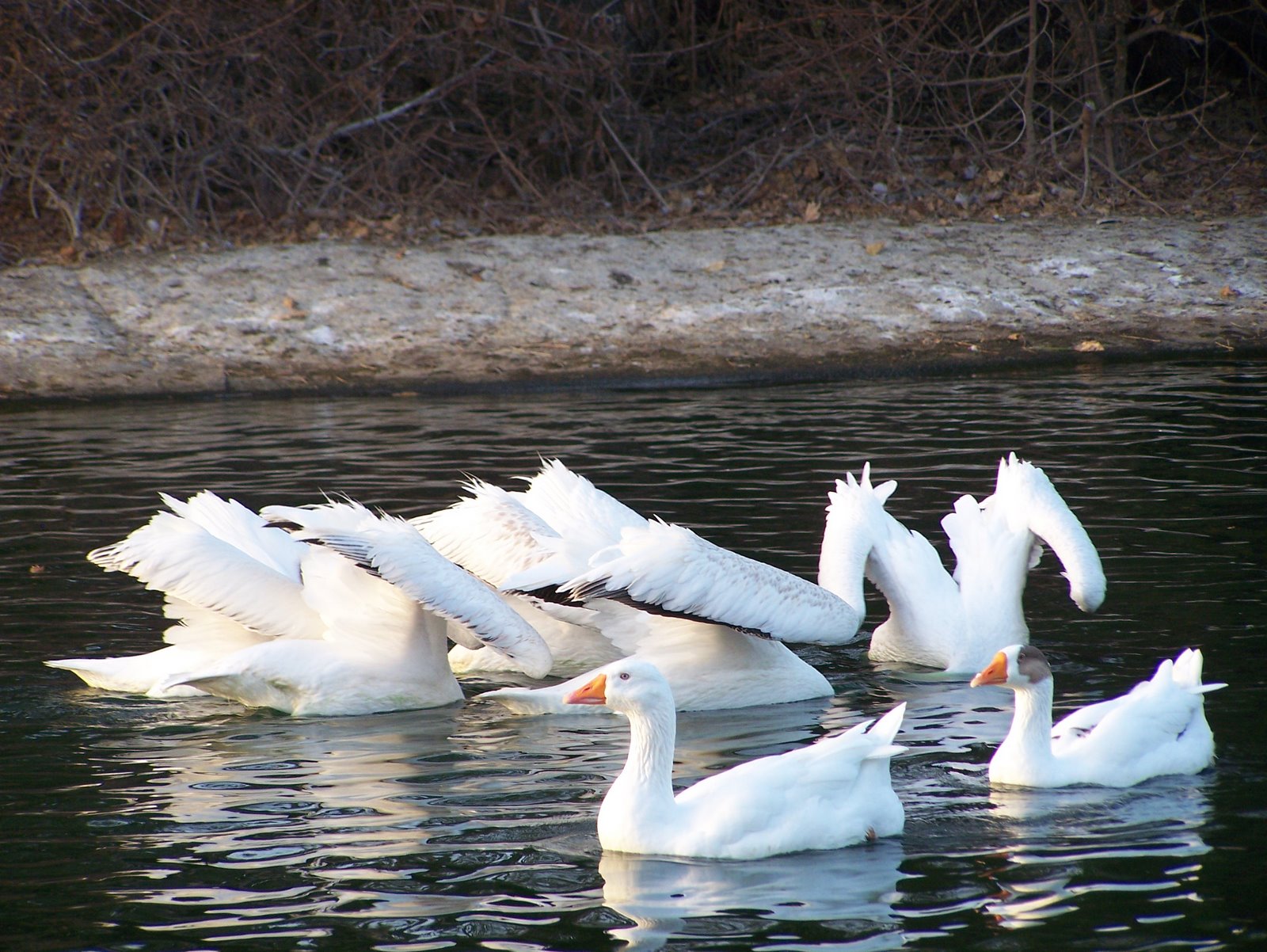
Although both eat fish, the fish in a completely different way. Brown Pelicans dive into the water, and American White Pelicans swim in unison until they find fish, herd them into a corner, and then all the pelicans stick their heads in the water at the same time. It is like synchronized swimming. I have seen a group of more than 50 individuals fish together like this. Believe me, it gets the attention of everyone there. It even attracts cormorants and other birds who hope to benefit by the fish herding skills of the American White Pelican.
 Small group of American White Pelicans attempt to catch fish they have herded.
American White Pelicans have been known to fish at night--especially during breeding season. They can feel the fish in the water and are able to fish by touch. See articles in link section below for references.

Notice that the black wing tips are totally hidden when the bird is at rest.
Below is a picture of American White Pelicans taken at a small city park in Huntington Beach called Carr Park. It has a small lake that is stocked with fish. It was crowded with coots, mallards, and American Wigeons, but that did not stop this small group of wintering American White Pelicans from cruising the lake and fishing. See below.

American White Pelicans fishing at Carr Lake in Huntington Beach.
You may find American White Pelicans during winter in any lake stocked with fish. You will also find them at Bolsa Chica Ecological Reserve in the deeper water and on occasion at the Upper Newport Bay in the deeper channels and in the deeper water. Though there were no reports at the Upper Newport Bay this year so far. You will also find them at San Joaquin Wildlife Sanctuary, and at Community Parks and regional parks such as Laguna Niguel Regional Park.
So the next time you are out bird watching near a body of water with lots of fish maybe you will be lucky enough to see the synchronized feeding of the American Pelican. It is a sight you will remember.
Links
All About Birds: American White Pelican
Detailed page about the American White Pelican.
Bird Web: American White Pelicans
State of Washington site about birds. Here is their article on the American White Pelican.
Diel Foraging Behavior of American White Pelicans (Pelecanus erythrorhynchos) on Experimental Aquaculture Ponds
Staff publication from the Wildlife Damage Management, Internet Center for USDA National Wildlife Research Center at the University of Nebraska. About when and how American White Pelicans feed. Paper by Scott J. Werner from the United States Department of Agriculture, Animal and Plant Health Inspection Service, Wildlife Services.
NOCTURNAL FORAGING IN THE AMERICAN WHITE PELICAN
Scholarly article on nocturnal feeding by Canadians Blair F. McMahon and Roger M. Evans in Condor from 1992.
Chase Lake NWR--American White Pelican
Breeding area for American White Pelicans.
Montana Field Guide: American White Pelicans
Montana field guide with lots of information. American White Pelicans breed in Montana.
National Audubon Society: American White Pelican
Detailed article about the American White Pelican.
Ungainly Grace: The American White Pelican
Detailed set of articles and photographs from National Geographic. Very good information. Don't forget to click on the links on the left side of the page. It is a set of articles, not just one.
Don't forget to check out the my blog post on Brown Pelicans. And my blog post comparing American White Pelicans and Brown Pelicans Pelicans in Orange County.
See OC Birder Girl Store on Amazon.
Subscribe to My Birding Blog: Posts (Atom)
Back to the home page
Newer Posts Older Posts
Tuesday, November 20, 2007
American White Pelicans--Pelecanus erythrorhynchos

Monday, November 19, 2007
Brown Pelicans--Pelecanus occidentalis
 Two Brown Pelicans: On the left, an immature and on the right, a mature. Please note that all pictures on this entire site are copyright Karen McQuade, the OC Birder Girl, unless otherwise noted.
Brown Pelicans are a mix of opposites. Grace in motion. And yet awkward and even funny as they splash into the water, or walk on the dry land. Pelicans are very large birds. They are 51 inches long and have a wingspan of 79 inches or about 6.5 feet. It takes a lot of fish to fuel that kind of bulk, and they are always on the move, looking their next meal.
 Mature Pelican in breeding plumage. At Bolsa Chica.
At my old job, we used to just walk around to the back of the building and we were looking out at the docks where the Catalina Express docked. If we walked a little down one way, we would walk up the Los Angeles River and see the Golden Shore Marine Reserve. If we walked the other way, we would see the area where the ocean met the river and it was more ocean than river. It was beautiful in many ways. It was a great place to bird at breaks and lunch. A birder's ideal job location. In fall and winter, the Brown Pelican returned to fish the mouth of the river and to fish the ocean. It is a very large bird. They would fly and plunge in to the water with a big, loud splash! They fish by diving head first into the water. The gulls --especially the Heerman's Gulls--would dog their every move, trying to steal the fish right out of their mouths. They are salt-water birds found at the beach, and estuaries, and tidal marshes like Bolsa Chica. We would often see them perched on light posts.
 A pelican with a pouch full of water and edibles at Bolsa Chica.
Brown Pelicans seem to take very little rest once they start fishing, diving repeatedly for fish. They fill their pouch with water and fish or crustaceans. That makes for a lot of weight. Notice that he leaves his bill in the water. The Brown Pelicans let the water drain out their partially open bills and then eat the fish. The crustaceans they work in the tip of their bills until they get the shell, if any off. Then they eat the insides. After that, it is up, up an away into the air to look for more, and then splashing down again to find more food. I mentioned before that gulls try to steal the fish right out of their mouths. One of the things that makes this a bit more easy is the way they catch their fish and crustaceans. They dive in the water, open their bills to get a mouthful of water and fish or crustaceans, and then open it again to drain the water out. See above.
 Triple play.
Brown Pelicans can be seen by the ocean--these are bi-coastal birds. Sit on the beach, and you will see Brown Pelicans gliding low over the waves. A beautiful and calming site. They are so graceful as they fly over the ocean. It is such a contrast with the big splash they make as they dive into the water like these three birds doing. Brown Pelicans fish alone or in small groups. West Coast and East Coast Pelicans actually have a slightly appearance. Instead of an olive or reddish pouch like the Western, the eastern Brown Pelican's pouch is brown or grayish. The Eastern Brown Pelican is also smaller than our Western Pelican. (Sibley, David, The Sibley Guide to Birds, page 47.) See a picture below of an east-coast Brown Pelican courtesy of the US Fish and Wildlife Service.
 Courtesy of the US Fish and Wildlife Service--an east-coast Brown Pelican
An endanged species, Brown Pelicans are very sensitive to the environment. In decades past their numbers were greatly reduced due to the pesticide DDT. Their numbers have bounced back with the banning of DDT. However, there are other dangers for the Pelican and other wildlife. In 2006, my supervisor asked me to go outside and investigate a Pelican sitting in the doorway of an adjacent building. I went outside an saw a very large Pelican just sitting there. It seemed ill. I called to get someone to pick it up. Animal control came and took it to a wildlife rescue center. It turned out to be a common occurrence. Evidently when algae blooms, it causes red tide. This produces domoic acid which can cause seizures and illness in many life forms from humans to Pelicans. Many birds have died from the toxins in red tide. According to an article from ABC Online, it was the toxins from the red tide that were thought responsible for birds--mostly Shearwaters--attacking people in the California Coastal town of Capitola. It was the incident that inspired the story the Birds on which Hitchcock based his movie. This type of aggression rarely happens. Usually stupor, disorientation, and seizures are the result of red-tide domoic acid poisoning.
 Immature Brown Pelican at Bolsa Chica
Brown Pelicans frequent the Bolsa Chica Ecological Reserve and nearby Bolsa Chica Beach flying over and diving into the water. You can also see an all-white Pelican--the American White Pelican--swimming and fishing at the Bolsa Chica Ecological Reserve, but not the Bolsa Chica Beach. The Brown Pelican is also frequently seen in estuaries, bays, rivers the are near the ocean, and up and down the coast. They are basically salt-water birds. The American White Pelican is basically a fresh-water bird.

Mature Brown Pelican at Bolsa ChicaPelicans are amazing birds and well worth watching and preserving. Next time you are out birding near the ocean, look for this large, beautiful bird. Check out the links below for more information, pictures, and videos about the Brown Pelican.
Links
All About Birds: Brown Pelican
Detailed page about the Brown Pelican.
Animal Diversity Web: Brown Pelicans
Good article with lots of detail.
Smithsonian National Zoological Park Fact Sheet on Brown Pelicans
Good information.
Pelicans in Peril
How algae bloom's red tide affects Brown Pelicans. The main reason is domoic acid. Read the article and see what a problem this natural occurrence is.
Channel Islands Marine and Wildlife Institute: Domoic Acid Information and History
Very good article on the naturally occurring toxin and its effect on wildlife.
US Fish and Wildlife: Article on Brown Pelicans
Short, but good article on Brown Pelicans.
US Fish and Wildlife Endangered Species Listing: Brown Pelican
Information on the endanged status of the Brown Pelican.

Immature resting.
Pictures
Vireo Brown Pelican Pictures
Videos
Internet Bird Collection: Brown Pelican Videos
Great collection of Brown Pelican Videos. Note the difference between west coast and east coast plumage.
From National Geographic: Pelicans and Penguins
Although this is presented dramatically as if the Pelicans are the interlopers, really this is an anchovy feast that many seabirds and others would attend. Any time there is an abundant food source, you will find many animals there to take advantage of it. That's just life.
 Two mature Brown Pelicans taking off for another dive.
Don forget to check out my article on the American White Pelican. And my blog post comparing Brown Pelicans and American White Pelicans: Pelicans in Orange County.
If you like my photographs and would like to buy posters, mugs, magnets, or clothing with those photographs on it, visit the OC Birder Girl Store at Cafe Press. I am just getting started.
See OC Birder Girl Store on Amazon.
Subscribe to My Birding Blog: Posts (Atom)
Back to the home page
Newer Posts Older Posts