Tuesday, October 2, 2007

Killdeer--Charadrius vociferus

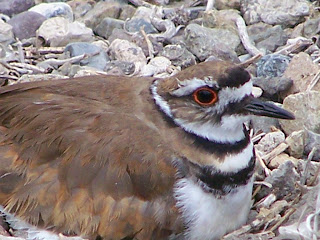
Killdeer on its nest at San Joaquin Wildlife SanctuaryI took pictures of this Killdeer on the nest at San Joaquin Wildlife Sanctuary


This little bird built its nest, or I should say scraped its nest in the gravel alongside the path near the Audubon House. I first saw it on the monthly walk at SJWS and later again a different week. Killdeer nest in gravel and flat surfaces and depend on camouflage and distraction displays to keep their eggs and young safe. Killdeer are part of the plover family. Plovers are small shore birds with bills that are short and thick. Killdeer are the only plover to have two bands across the chest. They also have a red ring around each eye. You can see it in the shot above.
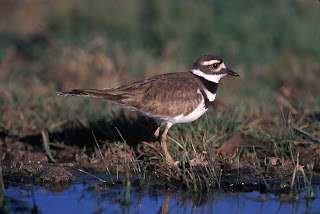

Killdeer photo courtesy of the US Department of Fish and Wildlife


Killdeer Photo Courtesy of the US Department of Fish and Wildlife


Killdeer are cute birds. They run around dashing from one thing to another like they have had too much caffeine. And are they loud! They don't call them Charadrius vociferus for nothing. Killdeer are nothing if not vociferous. They call loudly and repeatedly in flight, and are known to call at night. One of the few birds to do so. I can remember living by a wash near the future OC Performing Arts Center and hearing the Killdeer calling loudly all night long. It was not a restful bird song. They are named after the sound they make which sounds like Kill-dee, Kill-dee!! Which sounds like an alarm call. Like "Look out! Look out!" Or "Get out! Get out!" In spite of that, it is one of my favorite birds. I have seen it in fields, a parking lot by the Van Nuys Airport, a wash in Costa Mesa, Bolsa Chica, San Joaquin Wildlife Sanctuary, Upper Newport Bay Ecological Reserve aka Newport Back Bay , San Jacinto Wildlife Area, and many varied places.


Killdeer in the reeds at San Joaquin Wildlife SanctuaryKilldeer in the reeds and foliage at the first pond. San Joaquin Wildlife Sanctuary.


Killdeer a Bolsa ChicaKilldeer at Bolsa Chica


Killdeer eat many invertebrate (animals with no backbone) such as crustaceans, insects, worms and other like things in the fields, lawns, and shores they frequent. Sometimes they eat seeds. Like Snowy Egrets, they sometimes use a bit of foot action to stir things up and flush out their dinner.
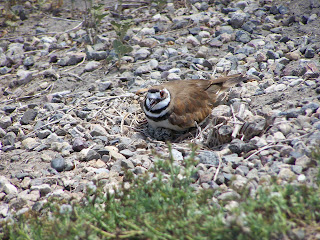

Killdeer at San Joaquin Wildlife Sanctuary
Killdeer getting uneasy about the presence of people on the path--which we never left. SJWS. Note the eggs under her breast.

Killdeer are widely distributed all over the United States. It is a shore bird, but is often seen far from shore in the desert, on the prairie, grass fields, asphalt parking lots, etc. Not exactly a nest-builder, it lays its eggs in a mere scrap in the ground or gravel. It has been known to nest lots of flat, fairly public, and unlikely areas including lawns and parking lots.


Killdeer eggs in nest at San Joaquin Wildlife Sanctuary

Killdeer eggs in the gravel. See how well they are camouflaged?


Killdeer put on a loud broken wing display to lure predators away from their nests. They flail and call loudly. It is quite a show. It's downright vociferous. Between the fact that the nest is so hard to see, and the distraction so loud and dramatic, it usually works. Even when I knew the eggs were there, it was really hard to see them. You can see them in the picture because I used my zoom to get a close-up. But if you pull back, in the midst of all that gray gravel, they seem to disappear.
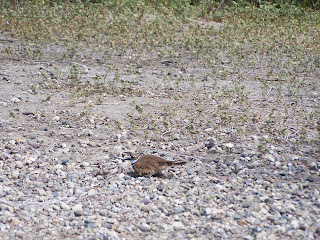
Killdeer on nest long shot at San Joaquin Wildlife Sanctuary

A shot with less zoom. See how hard it would be to see a little gray speckled egg?
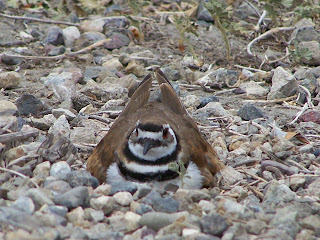
Killdeer on nest near path San Joaquin Wildlife SanctuaryMother Killdeer on the nest right near a path at San Joaquin Wildlife Sanctuary.
From the front. I twist and turn for Photographs. Actually I was kind of far away. Digital and optical zoom brings it close. Taken with a Kodak Easyshare with 10x optical zoom --6.1 MP.


Killdeer couple at San Jacinto Wildlife Area in Riverside County
Killdeer Couple at San Jacinto Wildlife Area in Riverside County. Quite a place by the way.


OC Birder Girl Links
External Killdeer Links and Resources


Birdwatching.com Killdeer Questions

Great Questions and answers about Killdeer nests.


Cornell's All About Birds: Killdeer

Very thorough article with bird call and maps.


The Precocious Killdeer


Birdwatching.com's article about the Killdeer.

US Geological Survey's Killdeer Charadrius vociferus


Short, but good.


Nature Works: Killdeer

Article on Killdeer.


Animal Diversity Web: Charadrius vociferus


Detailed information.


Montana US Fish and Wildlife: Killdeer


External Plover Links and Resources


eNature Plovers

List of US Plovers.


Encarta: Plovers


Encarta article on Plovers.

Click on the picture below to go straight to Amazon.com to see this and other birding items.


Home - Index - Contact - Shop -


Ask the OC Birder Girl

Monday, October 1, 2007

San Joaquin Wildlife Sanctuary

Audubon House at San Joaquin Wildlife Sanctuary


The San Joaquin Wildlife Sanctuary is managed by the Irvine Ranch Water District. Its functions include being a wildlife sanctuary and more practically, a natural water filter for the IRWD. So successful is it in this function that the IRWD and Orange County plan on building lots more. Lucky for us wildlife lovers, because it looks like they too will have a dual role as water filters and wildlife sanctuaries. The Audubon Society headquarters are here and many environmental groups meet in the other buildings here. Audubon has lots of activities for kids including a summer camp.


Pond #1


San Joaquin Wildlife Sanctuary has a long and varied history. Farming, gun clubs, wildlife preserve, and other uses I am sure. I heard the ponds were dug by the Duck club to attract waterfowl for their members to hunt. Some say the IRWD built them, but the timetable on the Audubon site seems to suggest that the duck clubs built them. For years, the ponds were listed on the local maps as "duck ponds."


Pond with Irvine in the background.


The first time I went to the SJWS in April of 1985, it was just an unkempt duck club. It looked pretty neglected. The last duck club closed shop in just three years later in 1988 (SJWS Timetable). My friend Gloria, her friend, Elizabeth, and I were let in by an Irvine Ranch Water District employee. He opened the gate and left us to ramble in the tangled under growth. And ramble we did with no clear map and only our sense of direction and a few words of guidance from the IRWD employee. We were amazed by the birds we saw. What stood out the most were the number of swallows there--hundreds and hundreds of various kinds. They were all over the chain link fences and shrubs. And the White-faced Ibises! We had never seen them before and didn't even know they were there.


It was April, 1985. We both had been birding only a few years, and I know we missed a lot. I wish my notes were better. But with that disclaimer, here is what I wrote down that I saw (updated species names):


Birds Seen April 1985.


  • Unknown number Rough-winged Swallows

  • Unknown number Red-winged Blackbirds

  • 1 Song Sparrow


One of the paths between the ponds.

It was hard to take in all the birds flying around us. When I think back on the way it looked when I first saw SJWS, I think that now it looks so civilized and refined. Then it was wild. The paths were not clear and a bit overgrown. It was exciting in a wild way that it isn't any more. Yet there is an excitement about coming up to a pond now and seeing what is out there swimming, diving, and wading. There is an accessibility that there wasn't then. I know where I am going and how to get back out. Nice, clear paths offer something else. A place for wildlife to share the paths with you. There is nothing like coming across a Great Blue Heron strolling along the same path as you are. Or to see a Bobcat early in the morning padding along the nice, broad paths. (I have seen a Great Blue Heron walking along the path, but have not yet seen a Bobcat.) Even hanging out by the Audubon House and seeing Turkey Vultures in the trees it something that gets a birder's blood running. Or seeing a clear view of a Common Yellowthroat in a tree or among the reeds. The swallows have houses, and there are maps to show the way through the Sanctuary--and bathrooms! What luxury! But most important, the wildlife is still there and thriving.


Killdeer on nest.

The Sea and Sage Audubon Society's Audubon House is a treasure trove--a tiny museum of stuffed birds, exhibits, and books. As well as Cd's, DVDs, tee shirts, and other bird stuff for sale. They hold events like an annual pancake breakfast, an annual barbecue, bat walks in the summer, a summer camp for kids, a monthly bird walk (second Sunday of every month), and much more. Birds abound in the SJWS. Especially in fall and winter. But spring is not too shabby either when birds are breeding and nesting. Just like the Killdeer above who nested very close to the path. She remained so still that many people never even saw her or her camouflaged eggs. I was lucky enough to have both pointed out to me. This little bird had nerves of steel. I was not as close as it looks--for those who might be concerned--I have a zoom lens.


Killdeer nest with eggs.


Mom finally took a break. Boy, these little eggs were hard to see when I walked by! Lucky for the Killdeer they are so hard to spot.
Come by and check out this wonderful Orange County birding hot spot and the terrific Audubon House. The San Joaquin Wildlife Sanctuary is Located at 5 Riparian View, Irvine CA 92612. It is east of the intersection of Jamboree and Michelson. For many birders this is one of the great places to see birds in Orange County. It has less people than Bolsa Chica, but lots of birds. Don't miss it. For directions and hours see the the Sea and Sage Audubon SJWS page.


A path and a pond.


Check out the links below.


Big fish in a duck pond. Now you know what draws the big birds!


Links:


Great Blue Heron standing on a path by several ponds.


San Joaquin Wildlife Sanctuary Links


Check out the bird checklist. Look at the trail map. Great timetable of the SJWS. The Audubon House at SJWS is full of books, videos, and all sorts of bird-related items. There are stuffed birds and animals that were not killed by Audubon but found dead already and taken to the taxidermist for preservation. Great education tool. They loan binoculars and have all kinds of handouts. They even sell some snacks. And there are some great volunteers here to chat with. There are bathrooms in a nearby building.


Black-necked Stilts hanging out.


Questions and Answers about the San Diego Watershed and the IRWD's Natural Treatment System

Brochures and links (don't miss the links at the top) about the IRWD Natural Treatment System and how they are expanding it.


Tree Swallow peeking out of nest box.


General Links


Orange County Memories--Duck Clubs


Orange County history blog. Post about the Duck Clubs in OC in years past.


Southern California Wetlands Recovery Project


The Orange County Wetlands Task Force.


The Birds of Orange County


This link goes to a list compiled by Peter J Bryant, School of Biological Sciences, University of California, Irvine. Part of a larger site the Natural History of Orange County. Helpful site.


View Larger Map

Home - Index - Contact - Shop - Ask the OC Birder Girl


Index of Posts to My Birding Blog

Home Page


Bird Profile--Birds of Orange County


Acorn Woodpecker--Melanerpes formicivorus
 
Allen's Hummingbird---Selasphorus sasin 

American Avocet--Recurvirostra americana

American Coot--Fulica americana

American Kestrel--Falco sparverius
 
American Robin--Turdus migratorius
 
American White Pelican--Pelecanus erythrorhynchos
 
American Wigeon--Anas americana
 
Anna's Hummingbird--Calypte anna
 
Audubon Yellow-Rumped Warbler--Dendroica coronata auduboni
 
Barn Owl--Tyto alba
 
Barn Swallow--Hirundo rustica
 
Belding's Savannah Sparrow--Passerculus sandwichensis beldingi
 
Black Phoebe--Sayornis nigricans

Black-crowned Night Heron--Nycticorax nycticorax

Black-necked Stilt--Himantopus mexicanus

Black Skimmer--Rynchops niger
 
Blue-winged Teal--Anas discors
 
Brown Pelicans--Pelecanus occidentalis

Cedar Waxwing--Bombycilla cedrorum
 
Cinnamon Teal--Anas cyanoptera

Common Yellowthroat--Geothlypis trichas
 
Cooper's Hawk--Accipiter cooperii

Double-crested Cormorant--Phalacrocorax auritus
 
Eared Grebe--Podiceps nigricollis

Great Blue Heron--Ardea herodias

Great Egret--Ardea alba

Green Heron--Butorides virescens
 
Great Horned Owl--Bubo virginianus
 
Green-winged Teal--Anas crecca
 
House Finch--Carpodacus mexicanus
 
Killdeer--Charadrius vociferus

Loggerhead Shrike--Lanius ludovicianus
 
Mallard--Anas platyrhynchos

Mandarin Duck--Aix galericulata

Marbled Godwit--Limosa fedoa

Mourning Dove--Zenaida macroura
 
Northern Harrier--Circus cyaneus
 
Northern Pintail--Anas acuta

Northern Shoveler--Anas clypeata

Osprey--Pandion haliaetus

Red-breasted Merganser--Mergus serrator
 
Redhead--Aythya americana
 
Red-shouldered Hawk--Buteo lineatus

Red-Tailed Hawk--Buteo jamaicensis

Ring-billed Gull-- Larus delawarensis
 
Ruddy Duck--Oxyura jamaicensis

Say's Phoebe--Sayornis saya

Sharp-shinned Hawk--Accipiter striatus 

Snowy Egret--Egretta thula

Surf Scoter--Melanitta perspicillata
 
Turkey Vulture--Cathartes aura 

Western Bluebird--Sialia mexicana
 
Western Grebes--Aechmophorus occidentalis

White-crowned Sparrows--Zonotrichia leucophrys


White-Tailed Kite--Elanus leucurus
 
Willet--Catoptrophorus semipalmatus
 
Wood Duck--Aix sponsa


Bird Profile--Rare Birds


American Bittern--Botaurus lentiginosus--A Rare Bird
 
Cattle Egret--Bubulcus ibis--A Rare Bird
 
Eurasian Wigeon--Anas penelope--A Rare Bird
 
Reddish Egret--A Rare Bird


The Rose-breasted Grosbeak--A Rare Bird


Bird Profiles--Bird Family


Wild Ducks of Orange County

The Herons and Egrets of Orange County
 
The Owls of Orange County


Bird Stories--Orange County


A Tale of Two Coots

Gopher Visits Alice's
 
Barn Swallow Nesting Time


Birding Equipment

About Binoculars


Birding Hot Spot--Orange County
 
Birding Hot Spots in Orange County, California
 
For my blog article on the Birding Hot Spots of Orange County, click the link above.


Bolsa Chica Ecological Reserve


Carr Park in Huntington Beach

Central Park in Huntington Beach
Environmental Nature Center

Greer Park Lake View

Irvine Open Space Preserve Nature Center

Irvine Regional Park in Orange, California
Mason Regional Park
Upper Newport Bay Ecological Reserve aka Newport Back Bay


San Joaquin Wildlife Sanctuary
A Walk at Santiago Oaks Regional Park


Tewinkle Park -- Costa Mesa
 
Barn Swallow Nesting Time


Ask the OC Birder Girl

Bird #1 and Bird #2
 
Mallards Nesting in Parking Lots


Birding Events

The Christmas Bird Count 

California Coastal Cleanup Day


What Birds Eat

What Birds Eat--Terrestrial Invertebrates


Birding Skills


Beginning Birders


Birding Code of Ethics from American Birding Assoc...


Orange County Bird Checklists


Parts of a Bird


Pishing


Wood Duck or Mandarin Duck?


Sapsucker, Which Sapsucker Are You?
 

How to Find a Rare Bird
 

Birding at Work


Northern Shovelers Feeding Cooperatively
 

Allen's Hummingbirds and Rufous Hummingbirds: What's the Difference?


What's That Singing in the Night?
 

Identifying Hawks in Orange County


White Hawk?


OC Birder Girl Birding Areas Outside Orange County


Crestline

Morongo


OC Birder Girl Bird Walk Journal
 

Birding at Work
 
Black Phoebe Visits
 
Early Morning Birding at Bolsa Chica
 
An Early Morning Walk at San Joaquin Wildlife Sanctuary
 
Foggy Bottoms at Bolsa Chica
 
The Hunt for the Cedar Waxwing
 
A Little Bit of Scotland in Huntington Central Park

Northern Shovelers Feeding Cooperatively
 
A Study in White
 
Two-stop Birding


A Walk at Bolsa Chica 2007

A Walk at Bolsa Chica Ecological Reserve 2009


A Walk at Bolsa Chica Before the Winds


A Walk in Huntington Central Park East


A Walk in Huntington Central Park West 10/15/2007


A Walk Among the Fall Leaves at Huntington Central Park
 
Wet and Wild at Bolsa Chica Ecological Reserve
 
Whistling Wintering Wigeons Are Back

White-crowned Sparrows at San Joaquin Wildlife Sanctuary

A Windy Walk at San Joaquin Wildlife Sanctuary
 
Central Park after the Rain

Wet and Wild at Bolsa Chica Ecological Reserve
 
Black Phoebe Visits
 
The Hunt for the Cedar Waxwing
 
Butterflies in Orange County

Cedar Waxwings Hanging Out


Book Reviews


Book Review: Good Birders Don't Wear White


Science

The Santa Ana Winds

Watershed--What is it?


Wetlands


Miscellaneous

Odd Ducks
  
Bird Walks and Nature Programs in Orange County

Ask the OC Birder Girl 

Information You Might Need Before You Go Birding
 
Watershed--What is it?
 
Bird Humor


Back to the home page